
Financial Goals by Life Stage: A Reference Guide

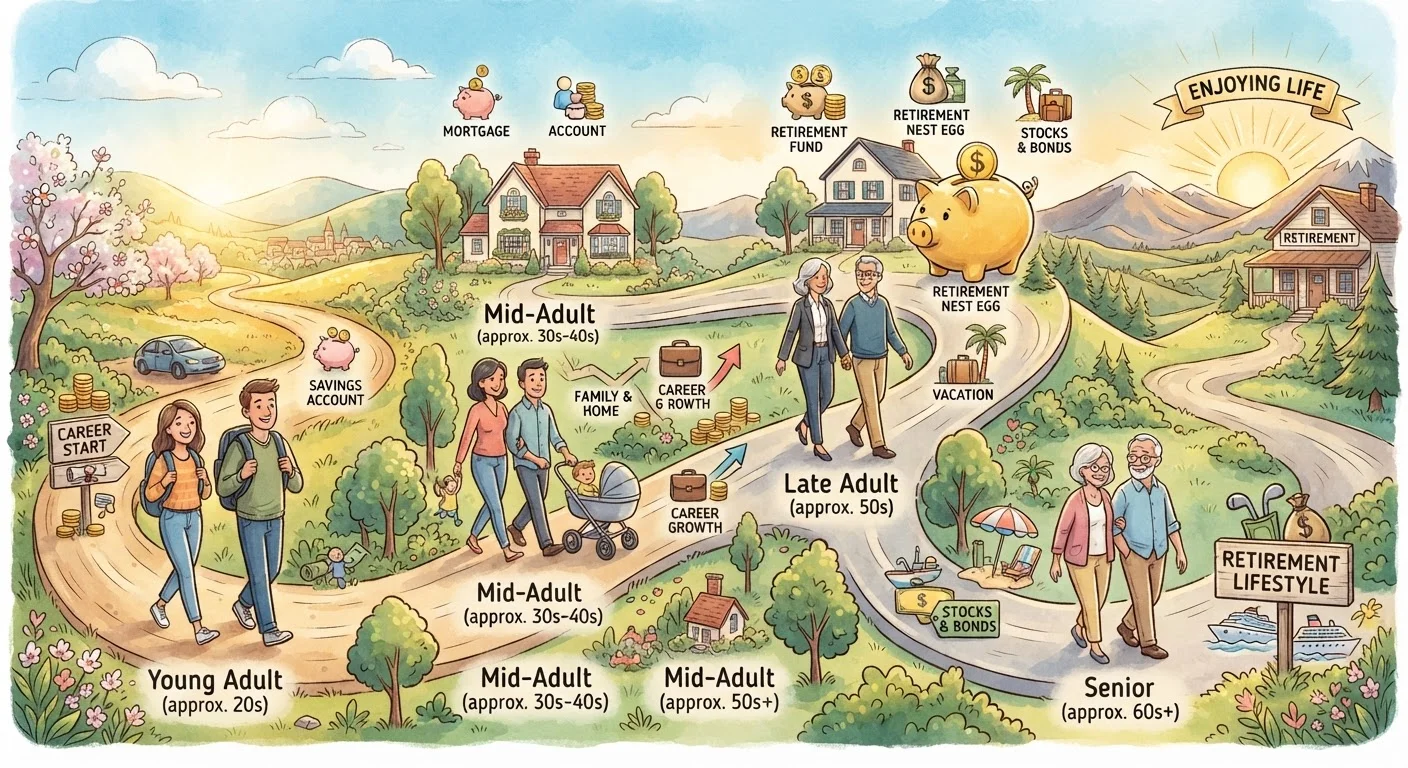
Photo: InDepthReads.com | Streamlining Learning For All editorial
Why Life Stage Matters for Financial Planning
Not every financial goal belongs on every person's list at the same time. A 25-year-old and a 55-year-old face fundamentally different income realities, time horizons, and risk tolerances. Organizing goals by life stage helps you focus energy where it matters most right now — and avoid the paralysis of trying to do everything at once.
This guide is a lookup-style reference, not a prescription. Your timeline may differ based on income, family structure, health, or career path. Use it as a starting map, then adapt it to your actual circumstances. For a deeper process, see our step-by-step financial goals walkthrough.
Your 20s: Build the Foundation
Early adulthood is the time to establish habits that compound over decades. Income is often lower, but time is a major asset — particularly for retirement saving.
- Emergency fund: Aim for three to six months of essential expenses in a liquid savings account before pursuing other goals.
- Debt management: Prioritize high-interest debt (credit cards, private loans). Understand your student loan repayment options.
- Retirement contributions: Contribute at least enough to capture any employer match in a workplace plan — that match is part of your compensation.
- Credit building: Establish a positive credit history through on-time payments and low utilization.
See our Saving & Debt hub for practical guidance on tackling debt while building savings simultaneously.
Your 30s: Grow and Protect
The 30s often bring higher earnings alongside bigger expenses — housing, children, career transitions. The central challenge is directing income gains toward long-term goals rather than only lifestyle upgrades.
- Home purchase (if applicable): Understand true costs beyond the mortgage: property taxes, insurance, maintenance, and opportunity cost.
- Life and disability insurance: If others depend on your income, coverage becomes essential financial infrastructure.
- Accelerate retirement saving: Increase contribution rates as income rises; consider tax-advantaged accounts beyond a basic workplace plan.
- Child-related planning: Education savings accounts can be started early; even small contributions benefit from long time horizons.
1 in 3
Americans with no retirement savings
Federal Reserve surveys have consistently shown that a substantial share of U.S. adults have no dedicated retirement savings at all.
10x
Retirement savings target by age 67
Several major financial education organizations suggest targeting roughly 10 times your final salary saved by full retirement age, though individual needs vary.
Your 40s and 50s: Optimize and Protect Wealth
Mid-life typically represents peak earning years — and a critical window to shore up retirement readiness before the final stretch. It is also when competing obligations (aging parents, college tuition, mortgage payoff) can derail progress.
- Retirement catch-up: Those 50 and older qualify for higher annual contribution limits in many tax-advantaged accounts — use them.
- Estate planning basics: A will, healthcare directive, and beneficiary designations are not optional at this stage; review them after any major life change.
- Debt-free target: Many financial planners suggest entering retirement without a mortgage or other significant debt to reduce fixed expenses.
- Long-term care awareness: This is a reasonable decade to start researching long-term care insurance options, as premiums are lower at younger ages.
Life changes in this period — job loss, divorce, medical costs — can disrupt even well-made plans. Our article on keeping financial goals on track when life gets unpredictable offers strategies for building in flexibility.
Your 60s and Beyond: Transition and Sustain
The years approaching and following retirement shift the financial focus from accumulation to distribution — making your savings last while managing health costs and fixed income streams.
- Retirement income planning: Understand how Social Security timing affects lifetime benefits; coordinate with other income sources (pension, withdrawals, part-time work).
- Required Minimum Distributions (RMDs): Tax rules require withdrawals from most retirement accounts beginning at a federally set age — plan for the tax impact.
- Healthcare costs: Medicare coverage gaps and out-of-pocket costs are among the largest variables in retirement budgets; model them explicitly.
- Portfolio risk adjustment: Conventional guidance suggests reducing exposure to volatile assets as you draw on savings, though appropriate allocation varies by individual circumstance.
No matter your stage, an annual review keeps your plan current. Use our annual financial goals review checklist to assess progress and recalibrate at least once a year. Just as nutrition needs shift across decades — as explored in our nutrition through every decade guide — so do financial priorities.
Emergency Fund
A dedicated pool of liquid savings set aside to cover unexpected expenses or income disruption. Most guidance targets three to six months of essential living costs.
Required Minimum Distribution (RMD)
The minimum amount the IRS requires you to withdraw annually from most tax-deferred retirement accounts once you reach a specified age. Failure to take RMDs results in a tax penalty.
Tax-Advantaged Account
A savings or investment account that offers a tax benefit — either a deduction on contributions (traditional) or tax-free growth and withdrawals (Roth). Examples include 401(k)s and IRAs.
Catch-Up Contribution
An additional amount above the standard annual limit that savers aged 50 and older are permitted to contribute to qualifying retirement accounts under IRS rules.
Asset Allocation
The division of an investment portfolio among different asset classes — such as stocks, bonds, and cash — typically adjusted over time to reflect changing risk tolerance and time horizon.
This article is for general informational and educational purposes only and does not constitute personalized financial, tax, legal, or investment advice. Consult a qualified financial professional for guidance specific to your situation.
The content on this site is for informational purposes only and is not a substitute for professional advice. Always consult a qualified professional for guidance specific to your situation.