
Debt Consolidation: What It Solves, What It Doesn't

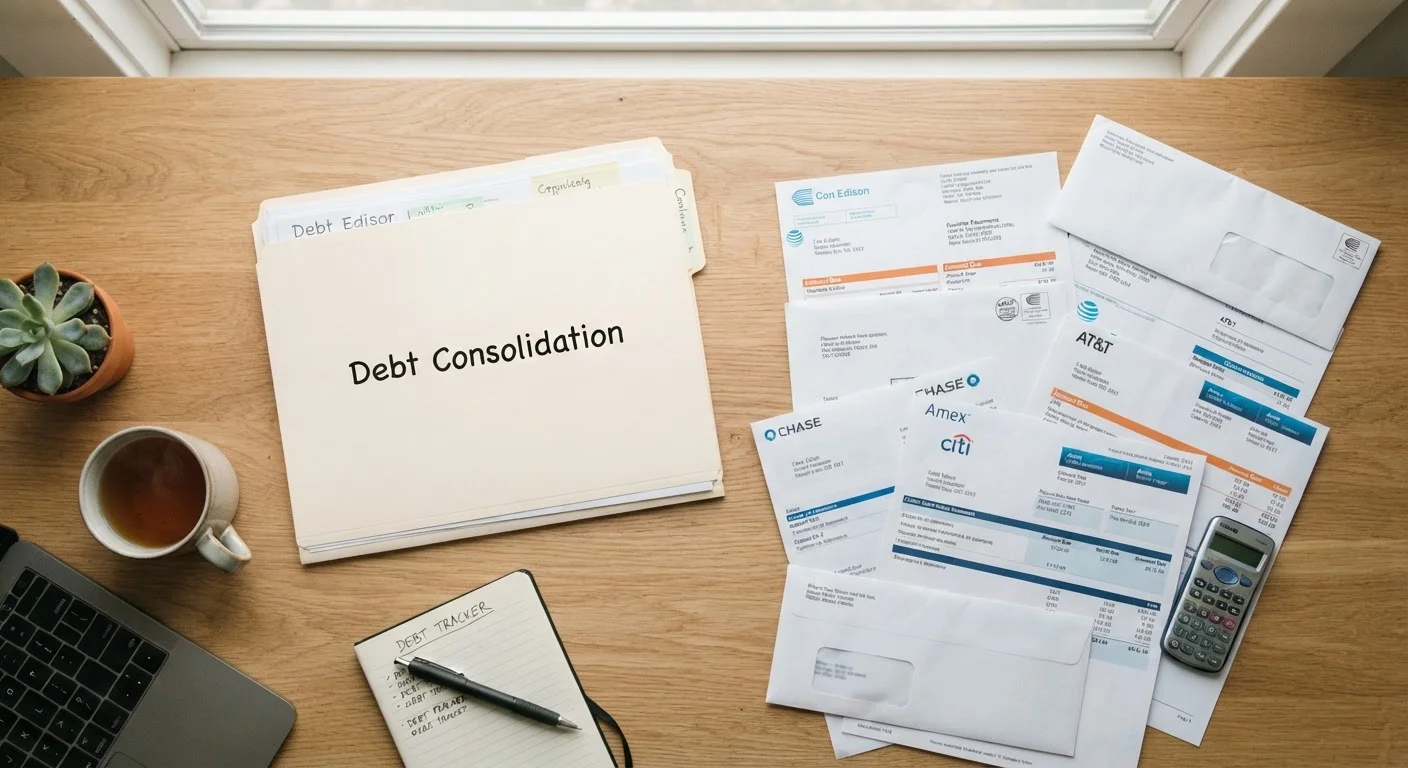
Photo: InDepthReads.com | Streamlining Learning For All editorial
Key Takeaways
- Debt consolidation combines multiple debts into a single payment, often at a lower interest rate.
- It works best for borrowers with good credit who are committed to changing spending habits.
- Consolidation reduces complexity but does not erase the underlying debt — the total owed remains.
- Extending your repayment term can lower monthly payments while increasing total interest paid over time.
- It is general financial education, not personalized advice — consult a qualified financial professional for your situation.
Lower interest rate reduces total cost of debt
If you qualify for a consolidation loan at a significantly lower APR than your existing balances, you will pay less interest over the repayment period — a direct, quantifiable saving.
Single monthly payment simplifies management
Replacing four or five due dates with one reduces the risk of missed payments, which protects your credit score and eliminates late fees.
Fixed repayment timeline creates a clear payoff date
Unlike revolving credit card debt that can stretch indefinitely, an installment consolidation loan has a defined end date, which can improve financial planning and motivation.
May lower required monthly payment amount
A longer repayment term can reduce the monthly cash outflow, freeing up room in a tight budget — though this trade-off requires careful consideration of total interest paid.
Can improve credit utilization ratio
Paying off credit card balances with a consolidation loan reduces revolving utilization, which is a significant factor in credit score calculations and may produce a score improvement.
Requires decent credit to get a useful rate
Borrowers with poor credit may not qualify for a rate low enough to make consolidation worthwhile — or may face terms that are worse than their current debts.
Longer terms increase total interest paid
Stretching repayment from three years to six years to lower the monthly payment often means paying more total interest, even at a lower APR. Running the full amortization math is essential.
Does not address the behavior behind the debt
If overspending or gaps in budgeting created the debt, consolidation alone will not prevent new balances from accumulating — a pattern sometimes called 'debt reloading.'
Origination fees and balance transfer costs add up
Many personal loans carry origination fees of 1–8% of the loan amount; balance transfer cards typically charge 3–5% of the transferred balance. These upfront costs reduce the net benefit.
Secured consolidation puts assets at risk
Home equity loans used for consolidation convert unsecured debt into debt backed by your home. If repayment becomes difficult, the stakes are considerably higher.
Credit score may dip initially
Applying for a consolidation loan triggers a hard inquiry, and closing old accounts can affect credit age and mix — both of which may cause a temporary score decrease.
What Debt Consolidation Actually Does
Debt consolidation means taking several existing debts — commonly credit card balances, medical bills, or personal loans — and replacing them with a single new loan or credit product. The goal is usually to secure a lower interest rate, reduce monthly payment complexity, or both.
The two most common vehicles are a personal consolidation loan (a fixed-rate installment loan used to pay off revolving debt) and a balance transfer credit card (which moves existing balances to a new card, often at a promotional 0% APR for a set period). Home equity loans and debt management plans through nonprofit credit counseling agencies are additional routes some households consider.
What consolidation does not do is reduce the principal you owe. You are restructuring the debt, not eliminating it. Understanding that distinction is the foundation of any honest assessment of this strategy. For a broader look at debt misconceptions worth clearing up first, see common credit card debt myths.
The Real Advantages
When the conditions are right, consolidation offers concrete, measurable benefits.
Lower interest rate reduces total cost of debt
If you qualify for a consolidation loan at a significantly lower APR than your existing balances, you will pay less interest over the repayment period — a direct, quantifiable saving.
Single monthly payment simplifies management
Replacing four or five due dates with one reduces the risk of missed payments, which protects your credit score and eliminates late fees.
Fixed repayment timeline creates a clear payoff date
Unlike revolving credit card debt that can stretch indefinitely, an installment consolidation loan has a defined end date, which can improve financial planning and motivation.
May lower required monthly payment amount
A longer repayment term can reduce the monthly cash outflow, freeing up room in a tight budget — though this trade-off requires careful consideration of total interest paid.
Can improve credit utilization ratio
Paying off credit card balances with a consolidation loan reduces revolving utilization, which is a significant factor in credit score calculations and may produce a score improvement.
20%+
Average credit card APR in the US
Federal Reserve data has consistently shown average credit card interest rates exceeding 20% APR, underscoring why a consolidation loan at a lower rate can produce meaningful savings.
3–8%
Typical personal loan origination fee range
Consumer Financial Protection Bureau guidance notes that origination fees on personal loans commonly range from 1% to 8%, a cost that must be factored into any consolidation calculation.
Simplifying multiple due dates into one also reduces the cognitive load of debt management — a factor that matters more than many budgets acknowledge. If debt stress is affecting your decision-making, understanding the psychology behind debt overwhelm can help put that experience in context.
Where Consolidation Falls Short
The disadvantages of debt consolidation are just as real — and they tend to hit hardest when borrowers treat consolidation as a finish line rather than a reset.
Requires decent credit to get a useful rate
Borrowers with poor credit may not qualify for a rate low enough to make consolidation worthwhile — or may face terms that are worse than their current debts.
Longer terms increase total interest paid
Stretching repayment from three years to six years to lower the monthly payment often means paying more total interest, even at a lower APR. Running the full amortization math is essential.
Does not address the behavior behind the debt
If overspending or gaps in budgeting created the debt, consolidation alone will not prevent new balances from accumulating — a pattern sometimes called 'debt reloading.'
Origination fees and balance transfer costs add up
Many personal loans carry origination fees of 1–8% of the loan amount; balance transfer cards typically charge 3–5% of the transferred balance. These upfront costs reduce the net benefit.
Secured consolidation puts assets at risk
Home equity loans used for consolidation convert unsecured debt into debt backed by your home. If repayment becomes difficult, the stakes are considerably higher.
Credit score may dip initially
Applying for a consolidation loan triggers a hard inquiry, and closing old accounts can affect credit age and mix — both of which may cause a temporary score decrease.
If you are weighing consolidation against staying the course with a structured repayment strategy, it is worth comparing against alternatives. The avalanche and snowball repayment methods offer a path that doesn't require qualifying for new credit and may cost less in total interest for disciplined payers.
Fitting Consolidation Into a Broader Financial Plan
Consolidation works best as one piece of a larger financial strategy, not a standalone fix. Before applying, it is worth mapping out a realistic budget that accounts for the new payment and leaves room for an emergency fund. Budgeting basics can help you build that framework before you commit to new loan terms.
One question that comes up frequently: should you pause savings contributions while paying down consolidated debt? There is rarely a single right answer. Paying off debt while saving at the same time explores how to balance both goals based on your interest rate environment and emergency fund status.
Nonprofit Credit Counseling Is an Option
This article is for general informational and educational purposes only and does not constitute personalized financial, tax, or legal advice. Consult a qualified, licensed financial professional before making decisions about your own debt management situation.
The content on this site is for informational purposes only and is not a substitute for professional advice. Always consult a qualified professional for guidance specific to your situation.