
Your First Budget: A Plain-English Starting Point

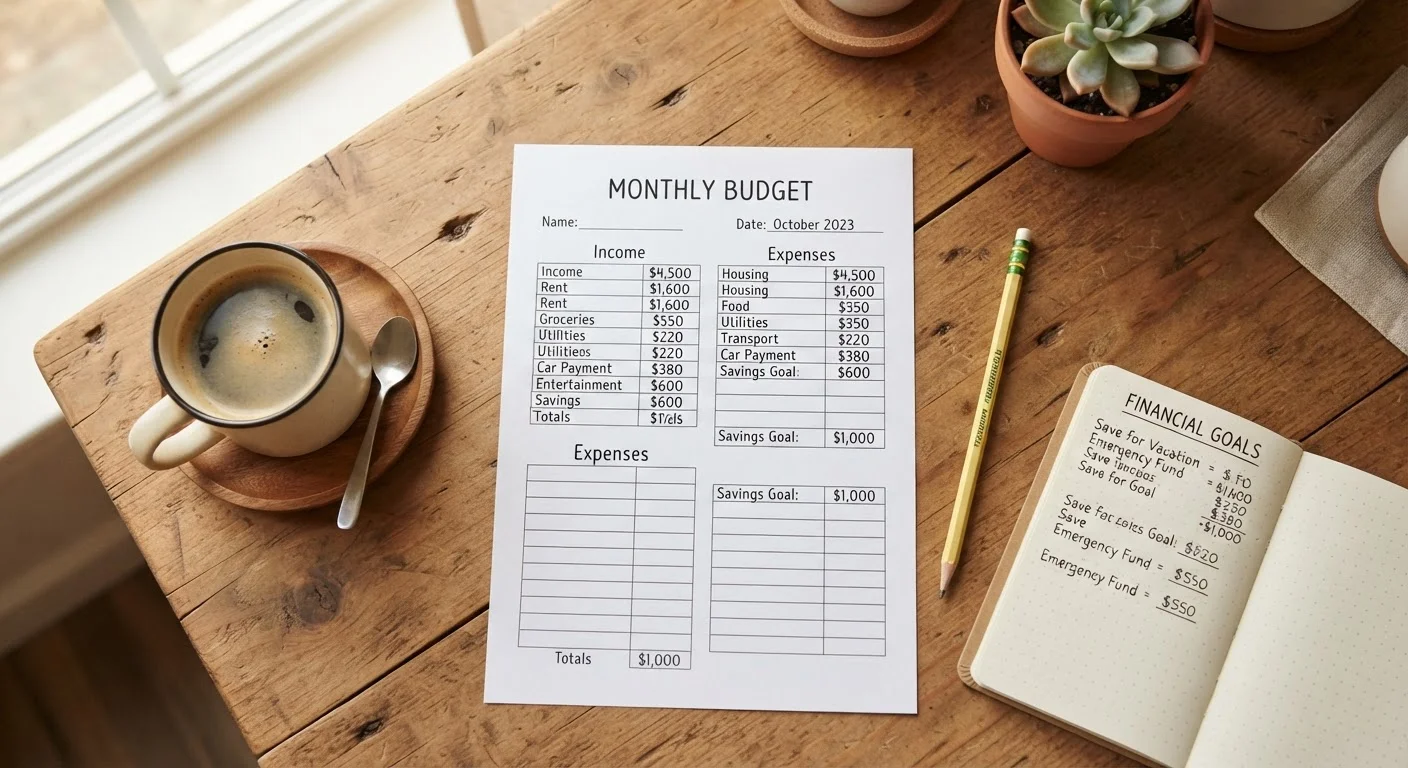
Photo: InDepthReads.com | Streamlining Learning For All editorial
Key Takeaways
- A budget is a written plan for your money — not a punishment or a restriction.
- Start with your actual take-home pay, not your gross salary, to avoid planning errors.
- Tracking spending for even two weeks reveals patterns most people don't expect.
- The 50/30/20 guideline offers a simple starting framework for most households.
- Your first budget will not be perfect — small adjustments over time are normal and healthy.
- Budgeting is a skill that improves with practice, not a one-time fix.
What a Budget Actually Is (and Isn't)
A budget is simply a written plan for how you intend to use your money during a given period — usually a month. That's it. It is not a spreadsheet designed to make you feel guilty, a sign that you're struggling financially, or something only accountants understand. It's a decision made in advance rather than discovered after the fact.
Many people avoid budgeting because they associate it with deprivation. But a budget doesn't tell you to stop spending — it tells you where you're spending so you can decide whether that reflects what you actually want. If you'd like to clear up other common misconceptions, see what the evidence says about budgeting myths.
Take-home pay
The amount deposited into your account after taxes and other payroll deductions are removed. This is the number to use when building a budget.
Fixed expense
A cost that stays the same each month, such as rent or a car loan payment. Fixed expenses are predictable and easier to plan around.
Variable expense
A cost that changes from month to month, such as groceries, gas, or dining out. These are often where budgets have the most room to adjust.
Discretionary spending
Money spent on non-essential items you choose to buy — entertainment, hobbies, and dining out are common examples. This is distinct from spending on necessities.
50/30/20 guideline
A simple budgeting framework suggesting roughly 50% of take-home pay for needs, 30% for wants, and 20% for savings and debt repayment. It's a starting point, not a strict rule.
Step 1 — Know Your Real Take-Home Income
Before you allocate a single dollar, you need an accurate picture of what actually lands in your account each month. That means take-home pay — what's left after taxes, Social Security, Medicare, and any employer benefit deductions have been withheld. Using your gross salary (the number before deductions) will make your budget look more spacious than it really is.
If your income varies month to month — due to gig work, freelancing, or hourly shifts — use a conservative estimate based on your lower recent months. Budgeting on an irregular income requires a slightly different approach and is worth exploring if your paychecks aren't predictable.
Use Your Most Recent Pay Stubs
Step 2 — Map Where Your Money Goes
Most people significantly underestimate what they spend in certain categories — especially food, subscriptions, and small recurring purchases. Before writing a budget, spend one to two weeks simply recording every expense. You don't need to judge it yet; just observe it.
Sort your spending into two broad buckets: fixed expenses (rent, insurance, loan payments — amounts that don't change month to month) and variable expenses (groceries, gas, dining out, entertainment — amounts that fluctuate). This separation makes it far easier to spot where cuts are practical and where they aren't. For a structured approach to this exercise, mapping your real monthly cash flow is a useful next step.
Step 3 — Build a Simple Spending Plan
Once you know your take-home income and your actual spending, you can write a plan. A widely used starting framework is the 50/30/20 guideline: allocate approximately 50% of take-home pay to needs (housing, utilities, groceries, transportation), 30% to wants (dining out, hobbies, subscriptions), and 20% to savings and debt repayment.
These are rough proportions, not rigid rules. If you live in a high-cost city, your needs category may legitimately run higher. The goal is for your planned spending to equal — but not exceed — your income. Every dollar should have a purpose before the month begins.
If you're ready to take the next step beyond a monthly spending plan, setting financial goals when you're starting from zero will show you how to connect your budget to longer-term priorities. For building the savings habit specifically, practical low-friction saving approaches can help even on a modest income.
Don't Budget Based on Expected Income
What to Expect in Your First Month
Your first budget will almost certainly have errors — and that's fine. You'll likely forget a semi-annual expense, underestimate groceries, or discover a subscription you'd forgotten about. None of this means the process has failed; it means it's working. The budget is surfacing reality.
At the end of your first month, compare what you planned against what actually happened. Note the gaps without judgment, then adjust your categories for the next month. Over two to three months, most people find their estimates become increasingly accurate and their financial stress decreases noticeably — not because their income changed, but because uncertainty did.
Budgeting is a skill that develops through repetition. The version you build today will look different from the one you're running a year from now, and that's a sign of progress. For a more detailed roadmap of where to take your financial planning next, see the Financial Goals hub or the full step-by-step financial goals walkthrough.
This article is for general informational and educational purposes only and does not constitute personalized financial advice. For guidance specific to your circumstances, consider consulting a qualified financial professional.
Frequently Asked Questions
The content on this site is for informational purposes only and is not a substitute for professional advice. Always consult a qualified professional for guidance specific to your situation.