
The Trade-Offs of Home Workouts vs. Going to the Gym

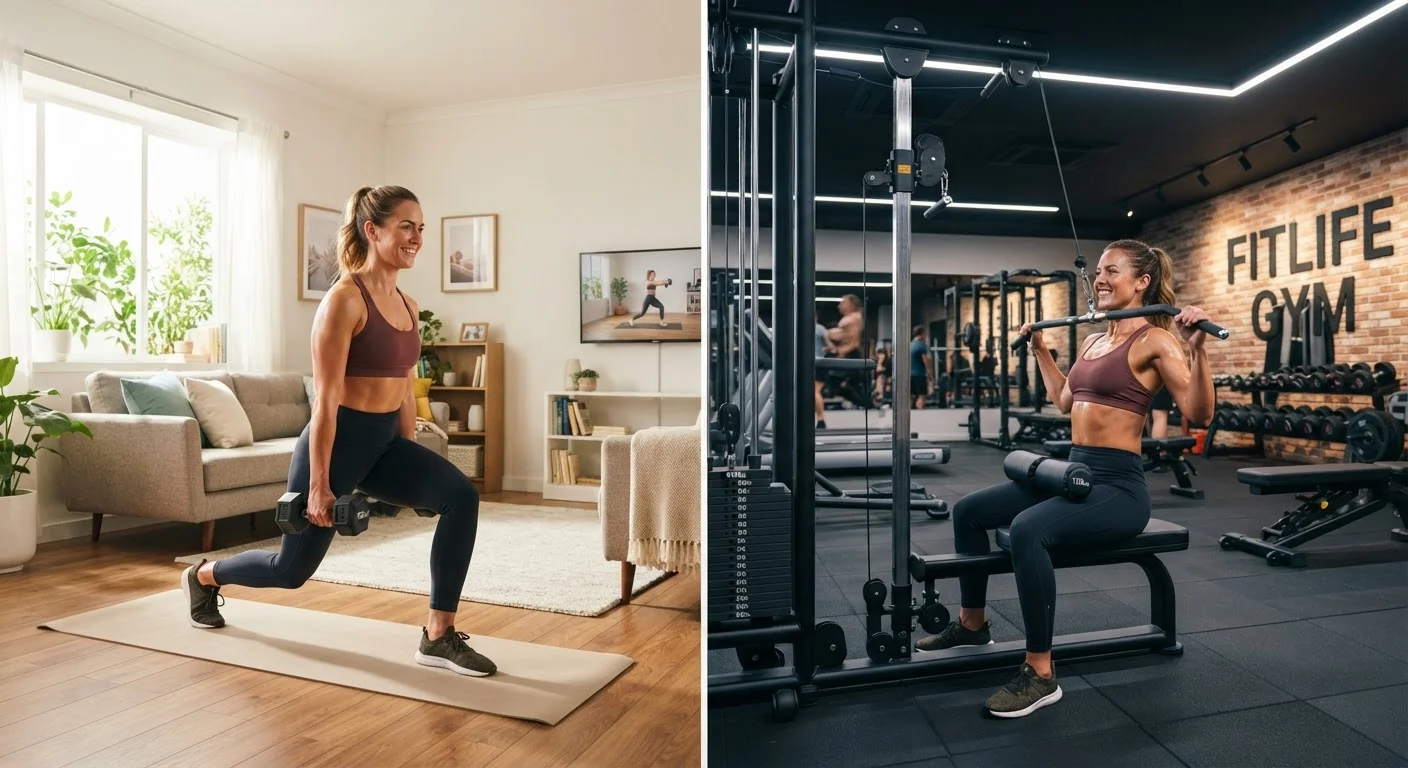
Photo: InDepthReads.com | Streamlining Learning For All editorial
Key Takeaways
- Home workouts offer maximum convenience but can limit equipment variety and social motivation.
- Gyms provide professional equipment and accountability but cost more and require travel time.
- Neither setting is universally superior — your goals, schedule, and personality shape the better fit.
- Many people benefit from combining both approaches rather than choosing one exclusively.
- Consistency matters more than location: the workout you actually do beats the ideal one you skip.
Zero commute — workout happens on your schedule
Eliminating travel time removes one of the most common reasons people skip sessions. A 20-minute workout at home is more achievable on a busy day than a gym trip that requires an extra 40 minutes of transit.
Lower ongoing cost with modest equipment
A foundational home setup — resistance bands, a mat, and adjustable dumbbells — can cost less than a few months of gym membership and lasts for years with no recurring fees.
Complete privacy and comfort
Exercising at home removes social self-consciousness, which is a real barrier for beginners or those returning after a long break. You can move at your own pace without comparison or judgment.
Available 24 hours a day
Home training has no opening hours, holiday closures, or peak-hour crowds. Early mornings, late nights, or split sessions throughout the day are all viable options.
Easier to combine with other responsibilities
Parents, caregivers, and remote workers can integrate short workouts into their day more fluidly when the training space is steps away from daily life.
Limited equipment constrains advanced progression
Building significant strength or muscle mass over time requires progressive resistance increases that a basic home setup may not fully support without substantial investment.
Higher potential for distraction and skipped sessions
Household tasks, family members, and digital devices compete for attention in ways that a dedicated gym environment largely eliminates. The mental boundary between 'home' and 'workout space' can be hard to establish.
No on-site instruction or professional guidance
Without access to trainers or experienced gym staff, form errors can go uncorrected over time — potentially increasing injury risk, particularly with complex movements.
Social motivation and accountability are absent
For exercisers who rely on group energy, visible effort from others, or social commitment to stay consistent, training alone at home removes these reinforcement mechanisms.
Why the Setting Matters More Than You Think
Where you exercise shapes more than convenience. Environment influences motivation, the types of movements available to you, injury risk, and — over the long run — whether you keep showing up at all. Research consistently shows that exercise adherence is one of the strongest predictors of fitness outcomes, which means the setting that keeps you consistent is, in practice, the better one for you.
Neither home workouts nor gyms are objectively superior. Both involve genuine trade-offs across cost, variety, accountability, and practicality. Understanding those trade-offs clearly is the first step toward building a routine that lasts.
This Is General Fitness Information
The Case for Working Out at Home
Home training has expanded dramatically in recent years. A growing library of bodyweight progressions, resistance band protocols, and compact equipment options means effective training no longer requires a commercial facility. For a closer look at building real strength without a membership, see strength training without a gym membership.
Zero commute — workout happens on your schedule
Eliminating travel time removes one of the most common reasons people skip sessions. A 20-minute workout at home is more achievable on a busy day than a gym trip that requires an extra 40 minutes of transit.
Lower ongoing cost with modest equipment
A foundational home setup — resistance bands, a mat, and adjustable dumbbells — can cost less than a few months of gym membership and lasts for years with no recurring fees.
Complete privacy and comfort
Exercising at home removes social self-consciousness, which is a real barrier for beginners or those returning after a long break. You can move at your own pace without comparison or judgment.
Available 24 hours a day
Home training has no opening hours, holiday closures, or peak-hour crowds. Early mornings, late nights, or split sessions throughout the day are all viable options.
Easier to combine with other responsibilities
Parents, caregivers, and remote workers can integrate short workouts into their day more fluidly when the training space is steps away from daily life.
The biggest practical advantage is the elimination of travel time and scheduling around gym hours. For someone managing a full-time job, family obligations, or irregular hours, a 30-minute home session that actually happens beats a 60-minute gym session that keeps getting postponed.
Cost is another significant factor. A modest investment in resistance bands, a yoga mat, or a set of adjustable dumbbells can serve years of varied training — with no recurring monthly fee.
The Drawbacks of Home Training
Home workouts come with real limitations, particularly as fitness goals become more advanced. Progressive overload — adding resistance over time to build strength — is harder to achieve without access to a full range of weights, cable machines, or barbells.
Limited equipment constrains advanced progression
Building significant strength or muscle mass over time requires progressive resistance increases that a basic home setup may not fully support without substantial investment.
Higher potential for distraction and skipped sessions
Household tasks, family members, and digital devices compete for attention in ways that a dedicated gym environment largely eliminates. The mental boundary between 'home' and 'workout space' can be hard to establish.
No on-site instruction or professional guidance
Without access to trainers or experienced gym staff, form errors can go uncorrected over time — potentially increasing injury risk, particularly with complex movements.
Social motivation and accountability are absent
For exercisers who rely on group energy, visible effort from others, or social commitment to stay consistent, training alone at home removes these reinforcement mechanisms.
Distraction and accountability gaps are also common challenges. Without a dedicated space or external social cue, it's easier to cut sessions short or skip them entirely. Some people find that the mental separation of leaving home to exercise is itself a meaningful part of their routine.
If your goals include significant muscle mass, sport-specific power training, or access to specialized equipment like rowing machines or cable systems, a home setup may require substantial investment to fully accommodate them.
~$50/month
Average U.S. gym membership cost
The International Health, Racquet & Sportsclub Association has reported average monthly gym fees in the U.S. ranging from roughly $40 to $60, excluding premium or boutique facilities.
1 in 3
Americans who rarely use their gym membership
Multiple fitness industry surveys have found that a significant share of gym members attend infrequently, highlighting the gap between membership cost and actual utilization.
What a Gym Membership Actually Offers
Commercial gyms provide access to a range of equipment that would cost thousands of dollars to replicate at home. Free weights across a full spectrum, cable stations, cardio machines, and dedicated stretching areas allow for greater training variety and more granular progression. This matters most for intermediate and advanced exercisers whose goals require more than bodyweight training can deliver.
The social environment is also a genuine advantage for many people. The presence of others — even strangers — can increase effort and consistency. Group fitness classes layer in structured instruction and community, which some exercisers find essential for long-term engagement. For those weighing structured group formats specifically, HIIT versus steady-state cardio is worth exploring to understand how different class formats serve different goals.
The Real Costs and Hidden Friction of Gym Memberships
Gym memberships vary widely in price, but the monthly fee is only part of the cost calculation. Commute time, parking, wait times for popular equipment during peak hours, and the mental overhead of packing a bag and traveling add friction that can erode consistency over time.
There's also the question of whether you actually use what you're paying for. Many people pay for gym access while working out infrequently, making the per-session cost far higher than it appears. Honest self-assessment of your usage patterns is more useful than comparing sticker prices.
Hygiene concerns, crowded facilities during peak hours, and lack of privacy are recurring friction points that drive some exercisers back toward home training. These aren't trivial; sustained discomfort in your training environment is a real barrier to consistency.
Making the Right Choice for Your Life
The most useful frame isn't "home or gym" but rather "what will I actually do consistently over the next six months?" Matching your environment to your personality and schedule matters more than optimizing for the theoretically superior setup.
People who are highly self-directed and time-constrained often thrive with home training. Those who struggle with self-motivation, benefit from coaching, or have goals that require heavy lifting tend to get more from a gym environment. Many exercisers find a hybrid approach works best: gym sessions for heavier training days, home workouts for lighter movement, mobility work, or days when time is short. For more on integrating mobility into a broader fitness plan, see how mobility and strength training relate.
If you're newer to exercise or returning after a break, starting with what's most accessible — likely at home — reduces the barriers to building the habit first. Equipment and environment can evolve as the routine solidifies.
This article is for general informational and educational purposes only and does not constitute medical or fitness advice. Consult a qualified healthcare provider or certified fitness professional before beginning or significantly changing an exercise program, especially if you have an existing health condition or injury.
The content on this site is for informational purposes only and is not a substitute for professional advice. Always consult a qualified professional for guidance specific to your situation.