
Fixed-Rate vs. Adjustable-Rate Mortgages

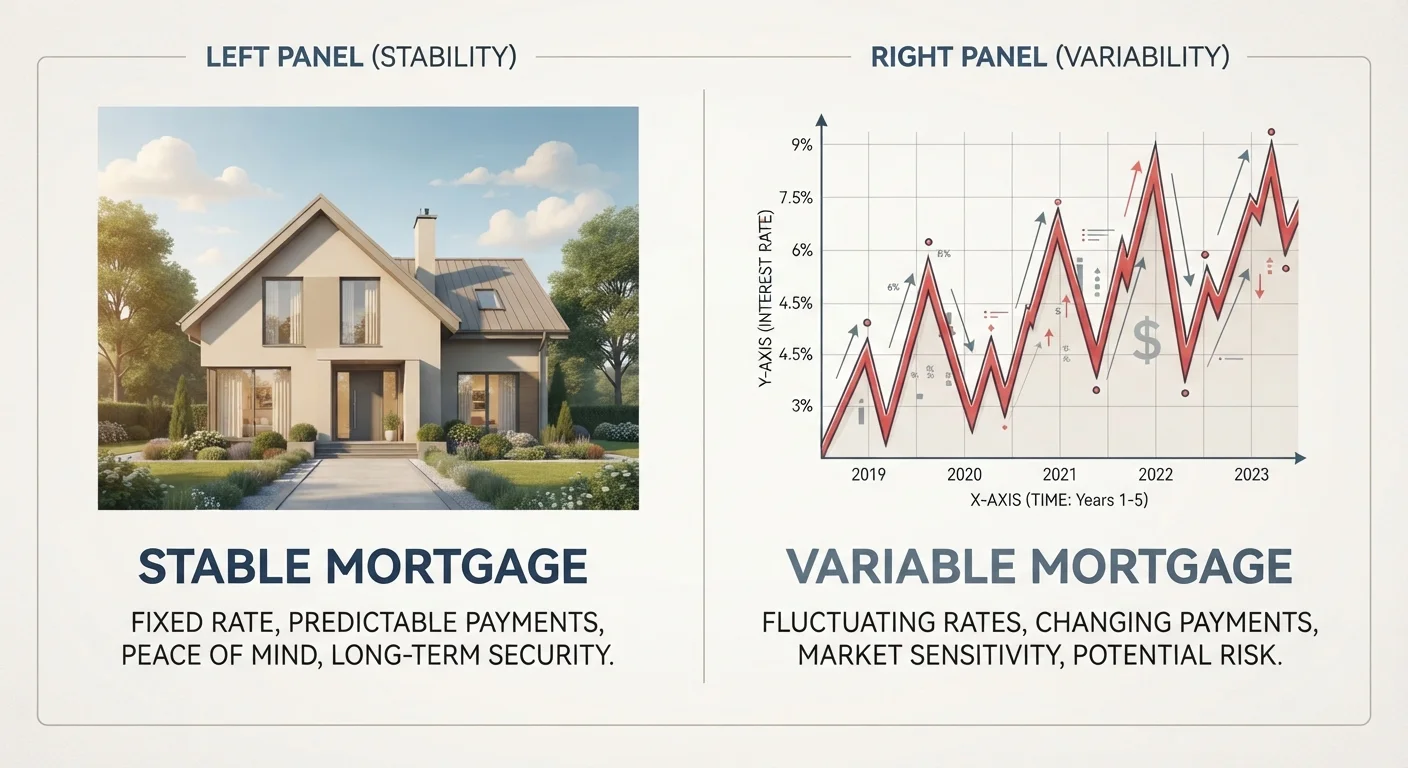
Photo: InDepthReads.com | Streamlining Learning For All editorial
Key Takeaways
- Fixed-rate mortgages lock in your interest rate for the entire loan term, providing payment certainty.
- Adjustable-rate mortgages start with a lower rate that resets periodically based on a market index.
- ARMs carry more long-term risk; your payment can rise significantly after the initial fixed period ends.
- Fixed-rate loans typically cost more upfront but protect against rising interest rate environments.
- Your expected time in the home is one of the most important factors in choosing between the two.
How Each Mortgage Structure Works
A fixed-rate mortgage carries the same interest rate from the first payment to the last. Whether the loan term is 15 or 30 years, the rate you lock in at closing is the rate you pay throughout. This means your principal-and-interest portion of the monthly payment never changes, even as market rates move in either direction. To understand why the early payments feel interest-heavy, see how mortgage amortization actually works.
An adjustable-rate mortgage (ARM) starts with a fixed introductory period — commonly three, five, or seven years — after which the rate resets at regular intervals (typically annually) based on a published market index plus a set margin. A 5/1 ARM, for example, holds its initial rate for five years, then adjusts once per year. Caps limit how much the rate can move per adjustment and over the life of the loan, but payment increases can still be significant.
| Criterion | Fixed-Rate Mortgage | Adjustable-Rate Mortgage (ARM) |
|---|---|---|
| Interest Rate | Locked for entire loan term | Fixed initially, then adjusts periodically |
| Initial Rate | Typically higher than ARM | Lower introductory rate |
| Monthly Payment Stability | Completely predictable | Can increase or decrease after adjustment |
| Rate Risk | None — borne by lender | Transferred to borrower after intro period |
| Common Loan Terms | 15-year, 30-year | 3/1, 5/1, 7/1 ARM structures |
| Best Holding Period | Long-term (10+ years) | Short-to-medium term (under 7 years) |
| Payment Caps | Not applicable | Initial, periodic, and lifetime caps apply |
The Real Trade-Offs Over Time
The core tension is between certainty and initial cost. Fixed-rate loans generally carry higher starting rates than ARMs, meaning your early payments are larger. Over a 30-year horizon, that premium buys you complete insulation from rate volatility — a meaningful form of financial stability that supports long-term budgeting. This is closely related to the broader principle explored in why fixed vs. variable expenses matter for budgeting.
ARMs transfer interest-rate risk to the borrower after the introductory period. If rates rise sharply — as they have in several historical cycles — a borrower's monthly payment can jump by hundreds of dollars at each adjustment, subject to the loan's cap structure. Conversely, if rates fall, ARM borrowers may see their payments decrease without refinancing.
~30 years
Most common fixed-rate mortgage term in the U.S.
The 30-year fixed-rate mortgage has historically been the dominant loan product chosen by American homebuyers according to Freddie Mac market data.
1–3%
Typical initial rate discount for ARMs vs. fixed
The rate spread between a 30-year fixed and a 5/1 ARM varies with market conditions; the discount is generally smaller when the overall rate environment is volatile.
The decision also intersects with how long you realistically plan to own the home. Buyers who know they'll move or understand the trade-offs between renting and buying within a few years may find the lower ARM introductory rate saves money before the adjustment window opens.
What to Consider Before You Choose
Before selecting a mortgage type, it helps to have a clear picture of your financial position — including what your lender has already evaluated. Understanding what mortgage pre-approval actually means can clarify which loan structures you qualify for and at what rates.
Key questions to weigh include:
- How long do you plan to stay? The break-even point between ARM savings and fixed-rate security typically falls around the end of the ARM's introductory period.
- How much payment variability can you absorb? If a significant rate increase would strain your budget, a fixed rate offers more protection.
- Where are rates in the broader cycle? When rates are already elevated, the spread between fixed and ARM rates may be narrower, reducing the ARM's cost advantage.
- What are the ARM's cap terms? Always review the initial cap, periodic cap, and lifetime cap before assuming your worst-case payment scenario.
ARM Cap Structures Matter
This article is for general informational and educational purposes only and does not constitute personalized financial or mortgage advice. Consult a licensed mortgage professional or financial adviser before making borrowing decisions.
The content on this site is for informational purposes only and is not a substitute for professional advice. Always consult a qualified professional for guidance specific to your situation.