
Renting vs. Buying: The Trade-offs Most People Miss

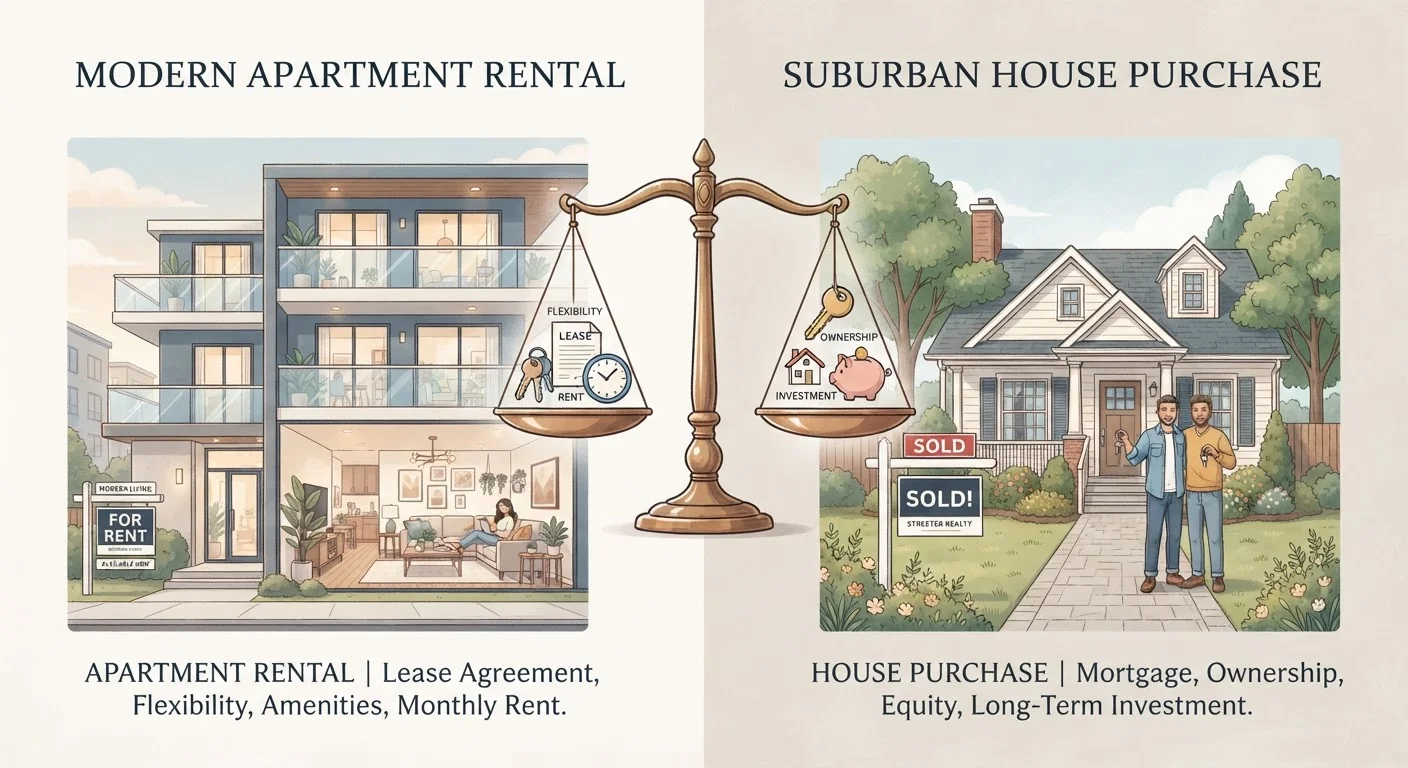
Photo: InDepthReads.com | Streamlining Learning For All editorial
Key Takeaways
- Buying costs typically run 2–5% of the purchase price in closing fees alone, before you make a single mortgage payment.
- Renting preserves liquidity and flexibility that ownership cannot easily replicate on short notice.
- Homeownership builds equity over time, but it also concentrates wealth in a single, illiquid asset.
- Your local price-to-rent ratio is a useful starting point for comparing the two paths in your specific market.
- The break-even timeline — how long before buying beats renting financially — varies widely by location and market conditions.
The Costs Most People Don't Factor In
The monthly payment comparison — mortgage vs. rent — is the starting point most people use, but it captures only a fraction of what each path actually costs. Buyers face upfront expenses that can run 2–5% of the purchase price in closing costs alone. On a $350,000 home, that's $7,000–$17,500 before you move in. See our breakdown of closing costs for a plain-language explanation of those fees.
Once in the home, owners absorb maintenance, repairs, property taxes, and homeowners insurance — expenses that renters largely avoid. A widely cited rule of thumb holds that annual maintenance costs roughly 1% of a home's value, though this varies considerably by age, condition, and location. A roof replacement, HVAC failure, or foundation issue can cost tens of thousands of dollars with little warning.
Renters carry costs too. Security deposits, renters insurance, application fees, and utilities not included in rent all add up. The full picture of renting costs is often larger than the advertised rent suggests — but it remains more predictable from month to month.
| Renting | Buying | |
|---|---|---|
| Upfront costs | Security deposit + first/last month | Down payment + closing costs (2–5%) |
| Monthly cost predictability | High (fixed lease term) | Variable (taxes, maintenance, repairs) |
| Equity accumulation | None directly | Builds over time with payments and appreciation |
| Flexibility to relocate | High (30–60 days notice typical) | Low (selling takes time and costs 5–8%) |
| Maintenance responsibility | Largely landlord's responsibility | Fully owner's responsibility |
| Wealth concentration risk | Diversified (invest the difference) | Concentrated in single illiquid asset |
| Stability of housing costs | Subject to rent increases at renewal | Fixed-rate mortgage locks principal/interest |
Equity, Wealth Building, and the Illiquidity Problem
One of the most-cited arguments for buying is equity accumulation — the portion of the home's value you own outright as you pay down the mortgage and (in favorable markets) as values appreciate. Over a 30-year horizon, this can represent significant wealth. However, that wealth is concentrated in a single, illiquid asset. Selling a home takes time, involves transaction costs typically ranging from 5–8% of the sale price, and is subject to market timing you may not control.
Renters who invest the difference between renting and owning costs — down payment, maintenance, taxes — can build comparable wealth through diversified financial assets, though this requires discipline and favorable market conditions. The comparison is genuinely close in many markets, and outcome depends heavily on local appreciation rates, investment returns, and individual behavior. A deeper look at the financial trade-offs breaks down the math on both sides.
Model Your Own Break-Even Timeline
Flexibility, Risk, and Life Circumstances
Flexibility is one of renting's most undervalued advantages. Renters can relocate with relatively little friction — typically with 30–60 days' notice — making renting better suited for people whose careers, family situations, or preferences may shift. Owners who need to move before reaching the break-even point on their purchase may sell at a loss or become accidental landlords. Understanding how market conditions affect your options as a buyer is particularly important before committing.
Buying concentrates financial risk in a single asset and a single location. If the local economy weakens or the neighborhood declines, a homeowner's wealth can suffer significantly. Renters transfer this risk to the landlord, gaining market exposure without property ownership risk.
Life stage matters too. Buying makes more financial sense when you have a stable income, a multi-year time horizon in one location, and adequate reserves not just for the down payment but for ongoing ownership costs. Those exploring down payment options should be aware that lower down payments typically increase monthly costs and require private mortgage insurance (PMI) until sufficient equity is reached.
Don't Confuse Emotional Readiness with Financial Readiness
Using the Price-to-Rent Ratio as a Starting Point
The price-to-rent ratio — calculated by dividing a home's purchase price by its annual rent equivalent — offers a rough gauge of whether a local market favors buying or renting. Ratios above 20 generally suggest renting may be more cost-efficient; ratios below 15 often indicate buying compares more favorably. This is a starting point for analysis, not a definitive answer, since it doesn't account for tax treatment, investment alternatives, or personal circumstances.
Markets vary enormously. In some metro areas, buying at current prices requires a very long break-even timeline; in others, monthly mortgage costs are close to or below comparable rents. Understanding local rental market dynamics can help renters assess whether conditions are likely to shift in their area.
For a fuller picture of what each path entails, a realistic side-by-side comparison of renting and buying can help frame the decision in terms that go beyond the monthly payment. Ultimately, the choice is personal — grounded in finances, lifestyle priorities, and local conditions that no single metric can fully capture.
This article is for general informational and educational purposes only and does not constitute financial, legal, or investment advice. Consult a qualified financial adviser or real estate professional for guidance specific to your circumstances.
The content on this site is for informational purposes only and is not a substitute for professional advice. Always consult a qualified professional for guidance specific to your situation.