
Renting vs. Owning: The Financial Trade-Offs Most People Overlook

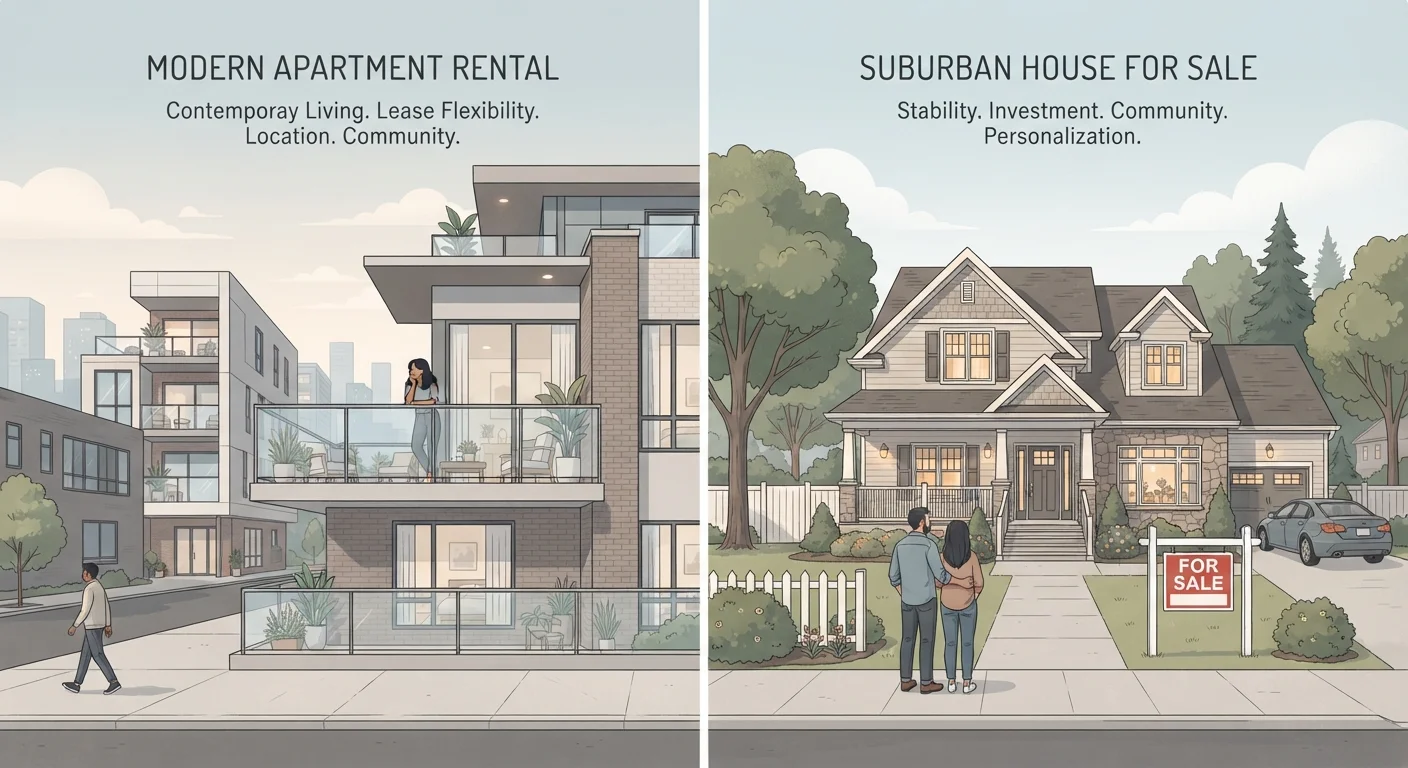
Photo: InDepthReads.com | Streamlining Learning For All editorial
Key Takeaways
- Owning a home builds equity over time, but comes with significant costs renters never face.
- Renting offers flexibility and predictable short-term costs, but no asset accumulation.
- Transaction costs like closing fees and agent commissions can erase early equity gains from buying.
- Maintenance, property taxes, and insurance add roughly 2–4% of a home's value annually to ownership costs.
- The financial advantage of buying typically requires staying in the home at least five to seven years.
- Neither path is universally superior — local market conditions, income stability, and life plans all matter.
The Costs Most People Compare — and the Ones They Miss
When people weigh renting against owning, the comparison usually starts and ends with the monthly payment. That framing misses a substantial portion of the real financial picture on both sides.
Renters pay a monthly amount that covers housing with limited additional obligations — but that figure doesn't build equity, and rent tends to increase over time. Owners pay a mortgage, but they also absorb property taxes, homeowner's insurance, routine maintenance, and periodic capital expenses like a new roof or HVAC system. These additional costs are frequently underestimated.
A useful rule of thumb holds that homeowners should budget roughly 1–2% of their home's value annually for maintenance alone — separate from taxes and insurance. On a $350,000 home, that's $3,500 to $7,000 per year before any mortgage payment. For a fuller picture of what renting actually costs end to end, see The Financial Realities of Renting.
| Criterion | Renting | Owning |
|---|---|---|
| Upfront costs | Security deposit, first/last month | Down payment, closing costs (2–5%) |
| Monthly obligations | Rent only (utilities may vary) | Mortgage, taxes, insurance, HOA |
| Maintenance responsibility | Landlord typically handles repairs | Owner fully responsible |
| Equity accumulation | None through housing payments | Builds over time with payments |
| Flexibility to relocate | High — lease terms are short | Low — selling takes time and costs |
| Exposure to market risk | Limited | Significant — values can fall |
| Predictability over 10+ years | Rent can rise substantially | Fixed-rate mortgage stays constant |
| Tax considerations | No housing-related deductions | Possible mortgage interest deduction |
Equity, Appreciation, and the Wealth-Building Argument
The most cited financial argument for homeownership is equity accumulation — the portion of the home's value you own outright as you pay down your mortgage. Over time, assuming the property holds or grows in value, this represents genuine net worth that renters don't build through their housing payments.
But the equity story is more nuanced than it first appears. In the early years of a fixed-rate mortgage, most of your payment goes toward interest rather than principal. Appreciation is also not guaranteed — housing markets can and do stagnate or decline in certain regions or time periods. And when you eventually sell, transaction costs (typically 5–6% in agent commissions, plus closing costs) reduce your net proceeds significantly.
5–6%
Typical home sale transaction cost
Agent commissions and closing costs on the sale side typically consume 5–6% of a home's sale price, significantly reducing net proceeds.
5–7 years
Average break-even horizon for buyers
Most housing economists and financial planners suggest buyers generally need five to seven years of ownership to offset upfront transaction costs.
1–2%
Annual maintenance budget guideline
A widely cited rule of thumb holds that homeowners should budget 1–2% of their home's purchase price each year for routine maintenance and repairs.
Renters who invest the difference between renting and owning costs may accumulate comparable wealth in some scenarios, though this depends heavily on discipline, investment returns, and local market conditions. The realistic trade-offs between renting and buying depend on factors specific to each person's situation.
The Break-Even Timeline: Why Duration Matters So Much
One of the most overlooked factors in the rent-vs-own decision is how long you plan to stay. Buying a home involves substantial upfront costs — down payment, closing costs typically ranging from 2–5% of the loan amount, moving expenses, and immediate setup costs. These costs take time to recoup through equity growth and appreciation.
Most financial analyses suggest a break-even point of roughly five to seven years, after which the financial case for owning generally strengthens relative to renting. Before that threshold, the transaction costs of buying and then selling can easily wipe out whatever equity was built.
The "How Long Will You Stay?" Test
This is why the question "Can I afford the monthly payment?" is incomplete. The more useful question is: "How long will I stay, and do the total costs of buying make sense over that horizon?" For those exploring lease structure and flexibility, month-to-month vs. fixed-term lease trade-offs are worth understanding.
Stability, Risk, and the Intangibles
Financial comparisons don't fully capture the non-monetary dimensions of this decision. Owning a home provides stability — the ability to renovate, stay long-term, and build roots in a community without the risk of a landlord's decision to sell or raise rent significantly. For families in particular, that predictability carries real value.
Renting, conversely, offers meaningful flexibility. Job changes, family shifts, or simply a desire for a different neighborhood are far easier to accommodate when you're not anchored by a property. This flexibility has real financial value that's hard to quantify but shouldn't be dismissed.
Risk also runs in both directions. Renters face the risk of rent increases and limited control over their living environment. Owners face market risk, the risk of costly repairs, and the liquidity risk that comes with having a large portion of net worth tied up in a single illiquid asset. Understanding your own risk tolerance and financial resilience is part of making a clear-eyed decision. For foundational budgeting context that supports any housing decision, budgeting basics offers practical starting points.
This article is for general informational and educational purposes only and does not constitute financial, legal, or investment advice. Consult a qualified financial professional for guidance tailored to your personal circumstances.
The content on this site is for informational purposes only and is not a substitute for professional advice. Always consult a qualified professional for guidance specific to your situation.