
Month-to-Month Rental vs. Fixed-Term Lease: What Changes and What Doesn't

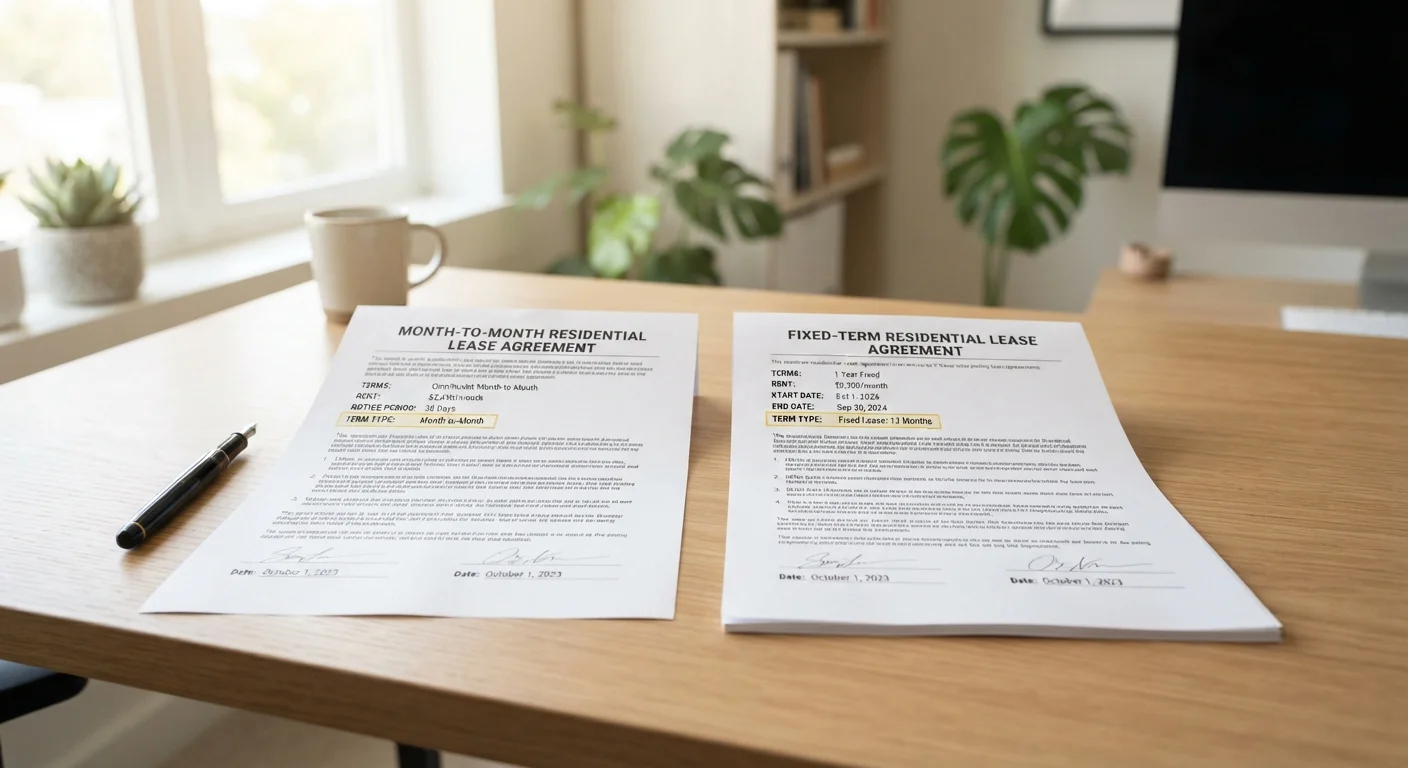
Photo: InDepthReads.com | Streamlining Learning For All editorial
Key Takeaways
- Month-to-month rentals offer maximum flexibility but typically come with higher rent and shorter notice protections.
- Fixed-term leases lock in rent and tenancy for a set period, protecting renters from mid-term rent increases.
- Landlords generally need to provide more notice to terminate a fixed-term lease than a month-to-month agreement.
- Breaking a fixed-term lease early can carry financial penalties; month-to-month agreements are easier to exit.
- Local laws significantly shape notice requirements and tenant rights under both agreement types.
- The right choice depends on your housing timeline, financial stability, and tolerance for uncertainty.
How the Two Agreement Types Are Structured
At their core, both a month-to-month rental and a fixed-term lease are legally binding contracts between a tenant and a landlord. What differs is the duration and how either party can exit. A fixed-term lease runs for a defined period — most commonly 12 months — and neither party can unilaterally end it before the expiration date without consequence. A month-to-month rental (sometimes called a periodic tenancy) has no set end date; instead, it automatically renews each month until one party provides proper notice to terminate.
After a fixed-term lease expires, many landlords allow it to convert to a month-to-month arrangement automatically if neither party takes action. This is worth confirming in your lease language before signing. See our guide to decoding lease language to understand the specific clauses that govern this transition.
| Criterion | Month-to-Month Rental | Fixed-Term Lease |
|---|---|---|
| Agreement length | Renews monthly, no set end | Set period (typically 12 months) |
| Rent stability | Can change with proper notice | Locked in for lease term |
| Typical rent premium | Often 10–20% higher | Generally lower monthly rate |
| Tenant exit notice | Typically 30 days written notice | Early exit may trigger penalties |
| Landlord termination notice | 30–60 days in most states | Cannot end before expiry without cause |
| Flexibility for relocation | High — short commitment | Low — tied to lease end date |
| Protection from displacement | Lower — easier for landlord to end | Higher — landlord locked in too |
| Best market conditions | Falling or stable rent markets | Rising rent markets |
Flexibility, Rent, and Cost Differences
The most immediate trade-off is between flexibility and cost. Month-to-month tenants can typically vacate with 30 days' written notice (sometimes 60 days, depending on state law), making these agreements appealing for anyone whose plans are fluid. However, that flexibility comes at a price: landlords routinely charge 10–20% more per month on rolling agreements compared to equivalent fixed-term units, reflecting the higher vacancy risk they bear.
Fixed-term leases, by contrast, allow landlords to plan their cash flow with certainty, which is generally why they're willing to offer lower monthly rents in exchange. For renters, the payoff is predictability — your rent is contractually frozen for the lease period regardless of what happens in the local market. In fast-moving rental markets, that protection can be substantial. For context on why rents shift, see how supply, demand, and seasonality shape rent prices.
30–60
Days' notice typically required to exit
Most U.S. states require 30 days' written notice for month-to-month terminations; some require 60 days for longer-tenured renters.
~12 months
Most common fixed-term lease duration
According to the U.S. Census Bureau's American Housing Survey, one-year leases are the dominant fixed-term arrangement in residential rentals.
10–20%
Typical month-to-month rent premium
Industry estimates from property management research consistently show month-to-month agreements priced above comparable fixed-term units in the same market.
Termination Rights and Legal Protections
One of the most consequential differences between these two agreement types is how each can be ended — by both the tenant and the landlord. Under a fixed-term lease, a landlord generally cannot terminate or refuse to renew without cause before the end date (with some jurisdiction-specific exceptions). Tenants who break a fixed-term lease early may be held liable for rent through the remaining term, though most states require landlords to make reasonable efforts to re-rent the unit and mitigate those losses.
Month-to-month tenants receive less security. Landlords can typically end the tenancy with 30 to 60 days' written notice in most states — no cause required in states without just-cause eviction laws. This asymmetry matters: a landlord can end your housing situation with a single notice letter if you're on a rolling agreement. Knowing your state's specific notice requirements is essential before choosing either structure.
If you're approaching the end of a fixed-term lease and weighing your options, what to review and negotiate at renewal covers the key pressure points in that conversation.
State Law Varies Significantly
What Stays the Same Under Both Agreements
Regardless of which type of agreement you sign, several tenant rights and landlord obligations remain constant. Habitability standards — adequate heat, plumbing, structural safety — apply equally under both structures in every U.S. state. Security deposit rules, anti-discrimination protections under the Fair Housing Act, and notice requirements for entry by the landlord are not waived simply because a tenant is on a month-to-month arrangement.
Subletting and lease assignment rules also apply to both structures, though the specific permissions depend on your contract language. Both agreement types can restrict or permit these arrangements; the key is what your written agreement says. See the differences between subletting and lease assignment if you're considering either option.
Ultimately, both month-to-month and fixed-term arrangements exist within the same legal framework — the differences lie in duration, pricing power, and exit terms, not in the fundamental rights either side holds. If you're also evaluating whether renting makes sense long-term, the trade-offs most people miss in the rent-vs-buy decision offers a broader framework for that comparison.
The content on this site is for informational purposes only and is not a substitute for professional advice. Always consult a qualified professional for guidance specific to your situation.