
Manual vs. Automatic Expense Tracking: Weighing the Trade-Offs

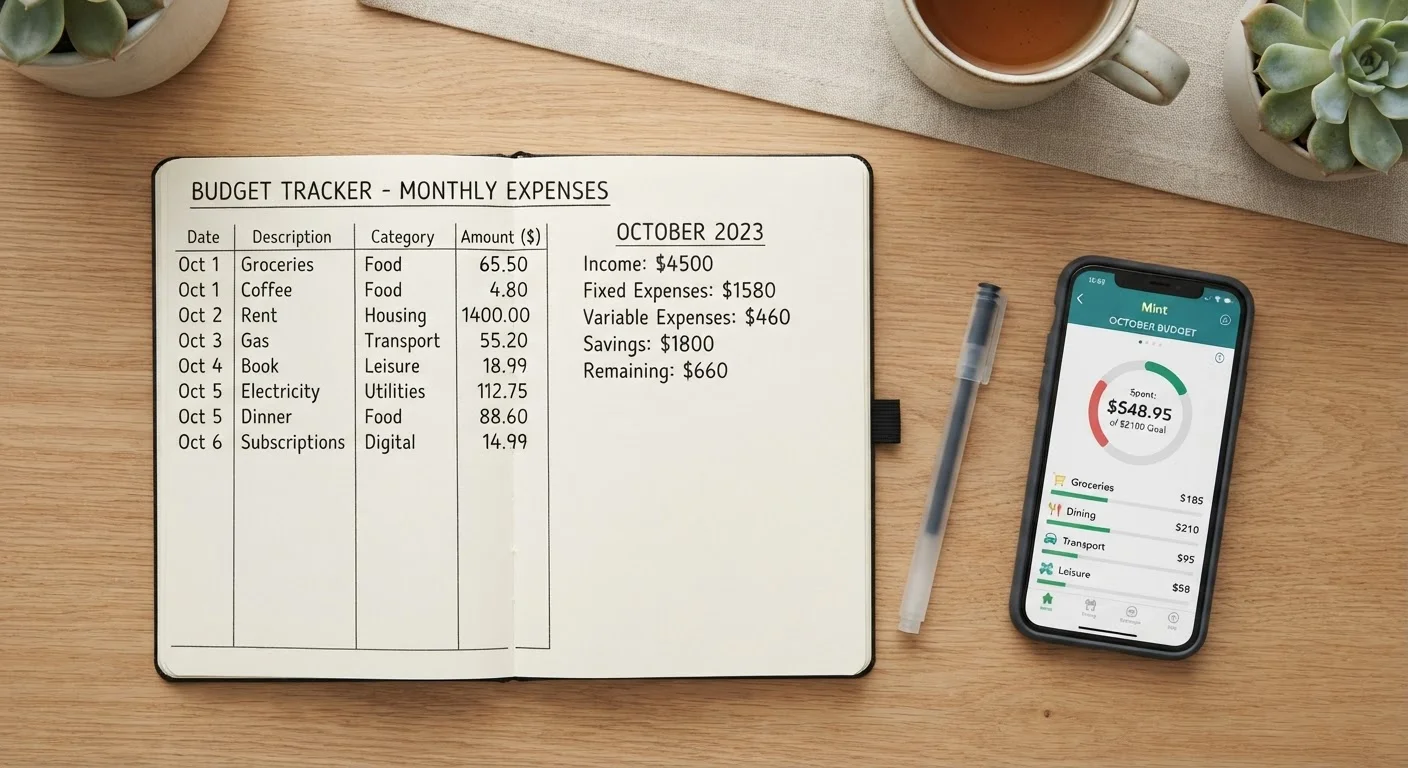
Photo: InDepthReads.com | Streamlining Learning For All editorial
Key Takeaways
- Manual tracking builds stronger spending awareness but requires consistent daily effort.
- Automatic tracking offers comprehensive coverage but can create a passive, set-and-forget mindset.
- A hybrid approach — automating capture while reviewing entries regularly — suits many households.
- Neither method eliminates budget drift on its own; the review habit matters most.
- Data privacy and app security are legitimate concerns with any bank-linked tracking tool.
Builds active spending awareness with every entry
The act of recording a purchase — even seconds after making it — creates a conscious link between behavior and budget that passive automation does not replicate.
No bank account linking or data privacy exposure
Manual systems require no third-party app access to financial accounts, which removes concerns about data breaches, credential sharing, or platform data policies.
Highly customizable to your own categories
A spreadsheet or notebook can be structured around exactly how you think about spending — no predefined categories to work around or rename.
Reinforces behavior change during high-motivation phases
For households actively cutting spending or paying down debt, the friction of manual entry can serve as a useful daily reminder of financial priorities.
Requires daily discipline to stay accurate
Even a few missed days can introduce gaps that undermine the reliability of the record, and most people find that consistency erodes over weeks or months.
Easy to forget cash and small transactions
Without a bank feed to capture every charge, small purchases — coffee, parking, a cash tip — frequently go unrecorded and can add up to meaningful blind spots.
Time-consuming across multiple accounts or earners
Households with two incomes, several accounts, and shared spending can find manual consolidation genuinely burdensome, increasing the likelihood of abandonment.
Passive review habit can reduce engagement over time
When data collects automatically, many users check their dashboards less frequently, allowing budget drift and miscategorized entries to accumulate unnoticed.
Auto-categorization errors distort spending totals
Algorithms misclassify transactions regularly — a home improvement purchase may read as entertainment — requiring periodic manual audits to keep data meaningful.
Third-party data access raises security considerations
Linking accounts to a budgeting app involves sharing credentials or API access; understanding a platform's data-sharing and breach-notification policies is important before connecting accounts.
What Each Approach Actually Means
Expense tracking sits at the core of any working budget. Whether you log purchases into a notebook, a spreadsheet, or let an app pull them automatically from your bank, the goal is the same: know where your money goes so you can direct it intentionally.
Manual tracking means you record each transaction yourself — by hand, in a spreadsheet, or by entering it into an app without a bank connection. Automatic tracking means a tool (usually a budgeting app or your bank's own interface) syncs directly with your accounts and categorizes spending without requiring you to enter individual items.
Understanding how your spending breaks down is easier when you already grasp the building blocks. See how fixed and variable expenses differ before deciding which tracking method fits your budget structure.
Manual vs. Automatic Is Not Either/Or
Advantages and Disadvantages of Manual Tracking
Writing down or typing in each purchase forces a moment of deliberate attention. Research in behavioral economics consistently finds that friction — even minor friction — changes decision-making. Manually logging a $14 lunch or a $6 app subscription makes the cost feel real in a way that a background sync does not.
Builds active spending awareness with every entry
The act of recording a purchase — even seconds after making it — creates a conscious link between behavior and budget that passive automation does not replicate.
No bank account linking or data privacy exposure
Manual systems require no third-party app access to financial accounts, which removes concerns about data breaches, credential sharing, or platform data policies.
Highly customizable to your own categories
A spreadsheet or notebook can be structured around exactly how you think about spending — no predefined categories to work around or rename.
Reinforces behavior change during high-motivation phases
For households actively cutting spending or paying down debt, the friction of manual entry can serve as a useful daily reminder of financial priorities.
The trade-off is sustainability. Manual tracking demands consistency. Miss a few days and the record becomes unreliable; miss a week and the method often collapses entirely. Cash transactions are also easy to forget, and shared household spending across multiple people and accounts can quickly become unmanageable.
Requires daily discipline to stay accurate
Even a few missed days can introduce gaps that undermine the reliability of the record, and most people find that consistency erodes over weeks or months.
Easy to forget cash and small transactions
Without a bank feed to capture every charge, small purchases — coffee, parking, a cash tip — frequently go unrecorded and can add up to meaningful blind spots.
Time-consuming across multiple accounts or earners
Households with two incomes, several accounts, and shared spending can find manual consolidation genuinely burdensome, increasing the likelihood of abandonment.
Passive review habit can reduce engagement over time
When data collects automatically, many users check their dashboards less frequently, allowing budget drift and miscategorized entries to accumulate unnoticed.
Auto-categorization errors distort spending totals
Algorithms misclassify transactions regularly — a home improvement purchase may read as entertainment — requiring periodic manual audits to keep data meaningful.
Third-party data access raises security considerations
Linking accounts to a budgeting app involves sharing credentials or API access; understanding a platform's data-sharing and breach-notification policies is important before connecting accounts.
For those actively working toward specific financial goals — such as eliminating credit card debt or saving for a house — the mindfulness that manual tracking creates can be genuinely motivating during the early stages of a plan.
Advantages and Disadvantages of Automatic Tracking
Automatic tools solve the consistency problem by removing human effort from data collection. Every debit card swipe, credit charge, and recurring subscription gets logged without you lifting a finger. For households juggling multiple accounts, this completeness is difficult to replicate manually.
~33%
Adults who track spending consistently
Various consumer finance surveys over recent years have found that roughly one-third of American adults track their spending on a regular basis, suggesting most households lack a complete picture of where money goes.
3–5x
Typical number of miscategorized transactions monthly
Personal finance practitioners commonly note that automated budgeting tools misclassify multiple transactions each month, underscoring the need for periodic manual review even in automatic systems.
The risk is disengagement. When data collects itself, it can sit unreviewed for weeks. Auto-categorization also makes errors — a hardware store purchase might land in "entertainment," and subscriptions that should be canceled often hide in a tidy list without triggering any alarm. Spending leaks that quietly erode a budget are just as easy to overlook in an automated system as in no system at all.
There are also legitimate privacy considerations. Bank-linked apps typically access your account credentials or use open-banking APIs. Understanding the data-sharing and security policies of any tool you connect to your accounts is a reasonable step before getting started.
Building a System That Works Long-Term
The method you actually use consistently will always outperform a theoretically superior method you abandon. A few practical principles help either approach hold up over time.
- Set a review cadence. Whether you track manually or automatically, a scheduled weekly or monthly review converts raw data into insight. The monthly financial review checklist can structure that habit regardless of how you collect spending data.
- Audit auto-categories regularly. Automatic systems make sorting errors. A quick scan once a month catches miscategorized charges before they skew your totals.
- Log cash manually. Even within an automatic system, cash spending needs a manual entry. Keeping a simple note on your phone for cash purchases closes this gap.
- Match the method to your phase. Someone rebuilding a budget after a financial setback may benefit from the awareness that manual entry forces. Someone maintaining a stable budget may find automation more sustainable. Consider switching approaches as your situation changes.
For a broader look at how different formats — envelopes, spreadsheets, apps — compare on similar dimensions, see budgeting methods compared. And if consistency has been the challenge, spending tracking habits that actually stick offers evidence-informed strategies to help the practice become routine.
This article is for general informational and educational purposes only and does not constitute personalized financial advice. Consult a qualified financial professional for guidance specific to your situation.
The content on this site is for informational purposes only and is not a substitute for professional advice. Always consult a qualified professional for guidance specific to your situation.