
Budgeting Methods Compared: From Envelopes to Spreadsheets to Apps

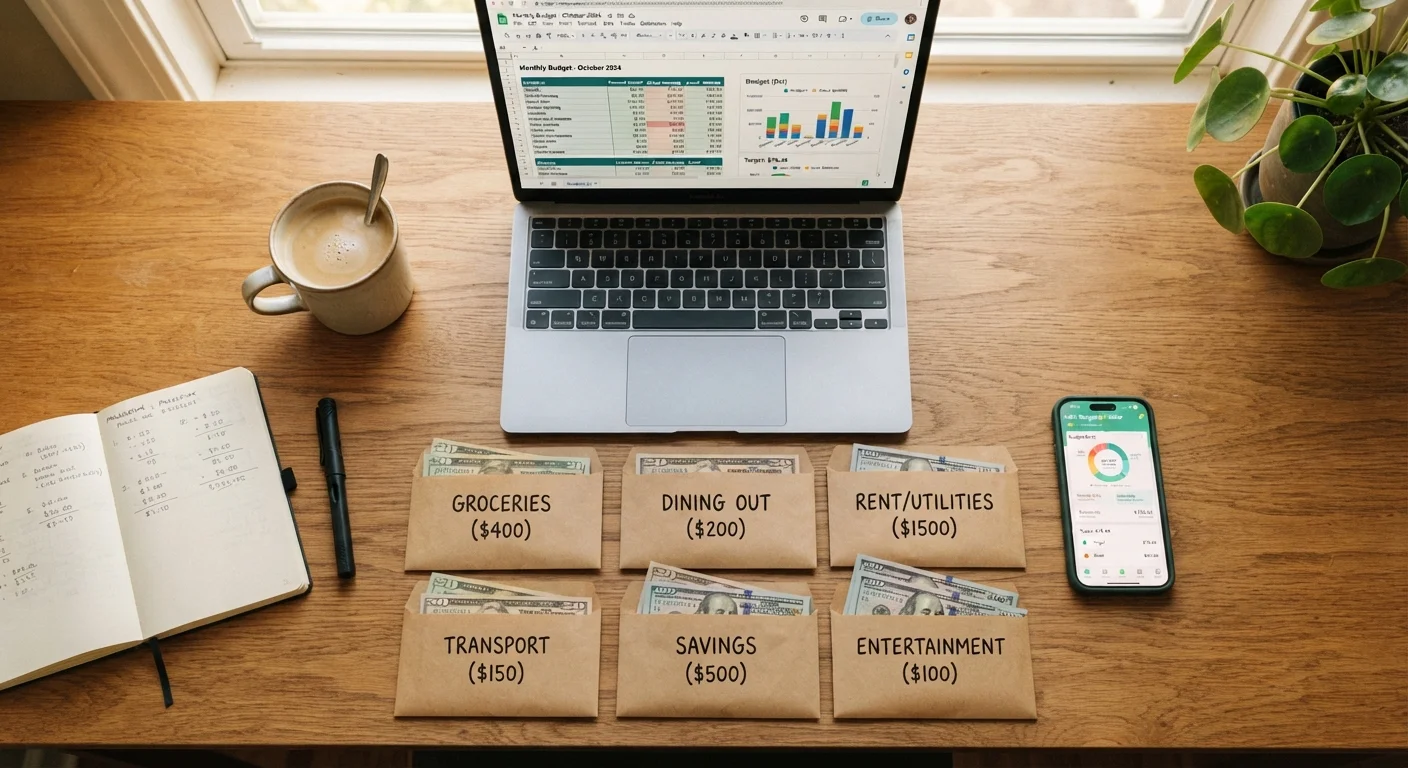
Photo: InDepthReads.com | Streamlining Learning For All editorial
Key Takeaways
- Cash envelopes create strong spending boundaries but require physical cash and regular replenishment.
- Spreadsheets offer full customization and transparency at no cost, but demand consistent manual upkeep.
- Budgeting apps automate tracking and offer real-time alerts, though they carry privacy and subscription trade-offs.
- No single method outperforms the others universally — the right fit depends on your habits and lifestyle.
- Hybrid approaches, such as using an app for tracking and envelopes for problem spending categories, are common and effective.
Why the Format You Choose Actually Matters
A budget only works if you use it consistently. That sounds obvious, but it's why so many people abandon budgeting after a few weeks — they chose a format that doesn't fit the way they actually live. If you're starting fresh, our plain-English guide to your first budget covers the foundational concepts before you commit to a method.
Each of the three main formats — cash envelopes, spreadsheets, and apps — carries real trade-offs in time, visibility, flexibility, and psychological effect. Understanding those trade-offs helps you pick the one most likely to stick.
| Cash Envelopes | Spreadsheet | Budgeting App | |
|---|---|---|---|
| Setup effort | Low — just cash and labeled envelopes | Medium — build or adapt a template | Low — account connection and onboarding |
| Ongoing time required | Moderate — weekly cash withdrawal | High — manual transaction logging | Low — mostly automated |
| Cost | Free | Free to low cost | Free tier or subscription fee |
| Works for online purchases | No — cash only | Yes | Yes |
| Customization | Limited to physical categories | Fully customizable | Moderate — app-defined structure |
| Privacy risk | None — no data sharing | None — local or personal cloud | Moderate — linked accounts |
| Psychological spending friction | High — physical cash | Medium — manual awareness | Low — card use unchanged |
| Household sharing | Difficult | Possible with shared file | Easy with shared account |
The Cash Envelope System
The envelope method is straightforward: you withdraw your budgeted cash at the start of each pay period and divide it into labeled envelopes — one for groceries, one for dining out, one for gas, and so on. When an envelope is empty, spending in that category stops.
The friction is intentional. Handing over physical bills registers differently in the brain than swiping a card, and that psychological effect is well-documented in behavioral economics research. For people who consistently overspend in specific categories, envelopes can create a hard boundary that digital tools cannot fully replicate.
The drawbacks are real, though. Carrying cash is inconvenient for online purchases, subscriptions, and automatic bill payments — categories that increasingly dominate household spending. You'll need a parallel system to track fixed, non-cash expenses. Envelopes also require a weekly or biweekly trip to the bank and careful handling to avoid loss or theft.
Hybrid Approach for Overspenders
Spreadsheet Budgeting
A spreadsheet — whether in a free tool like Google Sheets or a paid application — puts complete control in your hands. You define every category, set every rule, and see every number. For people who want to understand exactly where their money goes, this transparency is powerful.
Spreadsheets are also the most flexible format. You can model scenarios ("What if I cut dining by $150 and redirect it to my emergency fund?"), track month-over-month trends, and build in formulas that flag when you're approaching a limit. If you're working toward specific financial goals like saving for a home or paying off debt, a spreadsheet can map progress directly.
The cost is time. You must log every transaction manually — or at minimum reconcile imported data — to keep the numbers accurate. Many people start strong and lapse within weeks. The trade-offs between manual and automatic tracking are worth examining before you commit.
Budgeting Apps
Budgeting apps connect directly to your bank and card accounts, categorizing transactions automatically and surfacing spending summaries in real time. The main advantage is low friction: you don't have to log every purchase to get a reasonably accurate picture of your spending.
Most apps also offer alerts when you approach a category limit, goal-tracking features, and — in some cases — shared access for households. If you and a partner are budgeting together, a shared app account can reduce the coordination overhead significantly.
The trade-offs involve privacy and cost. Linking financial accounts to a third-party app means sharing sensitive data; it's worth reviewing any app's privacy policy and security practices before connecting accounts. Many capable apps also charge monthly or annual subscription fees. And because the automation does much of the work, some users find they're less engaged with their numbers — passive awareness isn't the same as active decision-making.
Review App Privacy Practices Carefully
Choosing Your Method — and Sticking With It
There's no universally superior format. The envelope system is best when spending discipline is the primary problem. Spreadsheets suit people who want granular control and are willing to invest time. Apps work well when consistency is the challenge and automation lowers the barrier to daily engagement.
Hybrid approaches are also legitimate. Many households use an app for overall tracking and envelopes only for two or three high-risk categories. Others keep a spreadsheet for annual planning and an app for daily monitoring. The goal is a system you'll actually return to each week.
If debt management is a parallel priority, methods like the avalanche and snowball approaches integrate naturally with any of these budgeting formats. Similarly, goal-based and zero-based budgeting philosophies are frameworks you can apply whether you're using cash, a spreadsheet, or an app.
This article provides general financial education and is not personalized financial advice. Consider consulting a qualified financial professional for guidance specific to your situation.
The content on this site is for informational purposes only and is not a substitute for professional advice. Always consult a qualified professional for guidance specific to your situation.