
Group Classes vs. Private Training Sessions: Weighing the Trade-offs

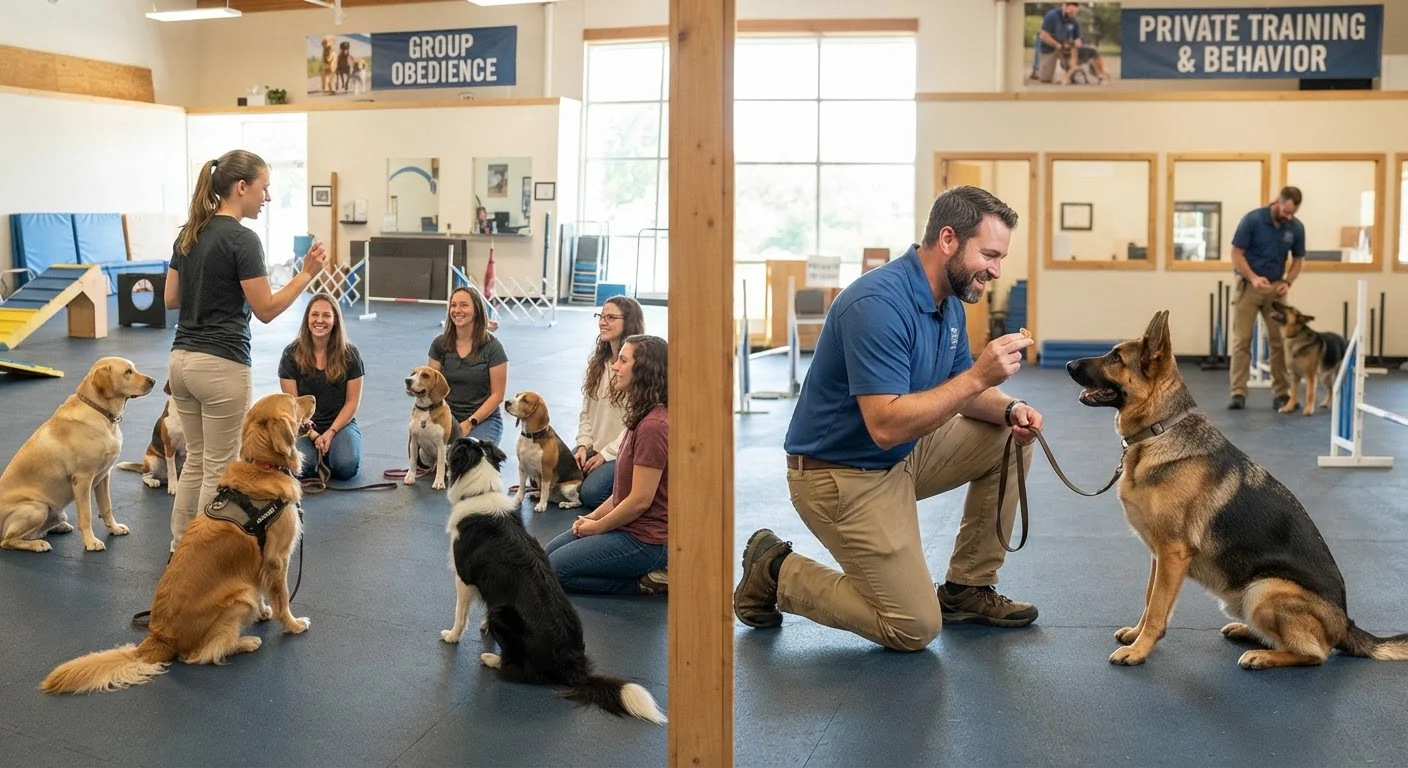
Photo: InDepthReads.com | Streamlining Learning For All editorial
Key Takeaways
- Group classes offer socialization opportunities and lower cost, but less individualized attention.
- Private sessions address specific behavioral issues with tailored, focused instruction.
- Your dog's temperament, reactivity level, and training goals should guide the format you choose.
- Many owners benefit most from combining both formats at different stages of training.
- Neither format is inherently superior — the best choice depends on your dog's specific needs.
Socialization in a supervised, structured environment
Group classes expose dogs to unfamiliar animals and people under trainer oversight, building generalized calm that transfers to real-world situations.
Lower cost per session than private training
Group formats spread the trainer's time across multiple participants, making them significantly more affordable — an important consideration for pet owners managing a household budget.
Handler accountability and peer motivation
Attending weekly alongside other dog owners creates consistent practice habits and keeps handlers engaged in the training process.
Covers core skills in a systematic curriculum
Most reputable group courses are structured progressively, building on foundational behaviors week by week in a logical sequence.
Real-world distraction training built in
Practicing commands around other dogs and handlers mirrors the kinds of distractions dogs encounter in parks, streets, and public spaces.
Limited individual attention per dog
With multiple dog-handler pairs in one session, trainers cannot observe every dog closely or provide tailored feedback in real time.
Not appropriate for reactive or anxious dogs
Dogs with leash reactivity, fear-based aggression, or significant anxiety may find group environments overwhelming, reinforcing the very responses training aims to reduce.
Curriculum is fixed, not customized
Group classes follow a set syllabus regardless of individual dogs' learning pace or specific problem behaviors outside the standard scope.
Private sessions cost significantly more
One-on-one trainer time is priced accordingly, and a full behavioral intervention program can represent a meaningful financial commitment over several weeks.
Less built-in socialization in private settings
Private sessions typically occur with one handler and one dog, so socialization with other animals must be arranged separately and intentionally.
What Each Format Actually Offers
Both group classes and private training sessions use the same core behavioral science — reward-based reinforcement, clear timing, and consistent repetition. Where they diverge is in structure, environment, and the level of individual attention your dog receives. Understanding these structural differences is the first step in matching the format to your situation.
Group classes typically run for six to eight weeks, covering foundational skills like sit, stay, recall, and loose-leash walking in a shared environment with multiple dogs and handlers. Private sessions, by contrast, are one-on-one appointments with a trainer — usually 45 to 60 minutes — that can address any skill or behavior concern in a setting you and your trainer control.
See our guide to the core principles of effective training for a deeper look at the behavioral foundations that underpin both formats.
Socialization in a supervised, structured environment
Group classes expose dogs to unfamiliar animals and people under trainer oversight, building generalized calm that transfers to real-world situations.
Lower cost per session than private training
Group formats spread the trainer's time across multiple participants, making them significantly more affordable — an important consideration for pet owners managing a household budget.
Handler accountability and peer motivation
Attending weekly alongside other dog owners creates consistent practice habits and keeps handlers engaged in the training process.
Covers core skills in a systematic curriculum
Most reputable group courses are structured progressively, building on foundational behaviors week by week in a logical sequence.
Real-world distraction training built in
Practicing commands around other dogs and handlers mirrors the kinds of distractions dogs encounter in parks, streets, and public spaces.
The Real Advantages of Group Classes
The most underappreciated benefit of group classes is structured socialization. Exposure to unfamiliar dogs and people — within a managed, trainer-supervised environment — builds the kind of calm, generalized confidence that matters in everyday life. Puppies and adolescent dogs especially benefit from normalized exposure to novel stimuli during critical developmental windows.
Group settings also hold handlers accountable. When you show up each week alongside other owners working through the same challenges, it creates a natural motivation to practice at home and follow through. Many owners report that the peer element of a class keeps them more consistent than solo training at home.
Cost is another real factor. Group classes cost significantly less per session than private training — often a fraction of the price — making them accessible for households managing a pet budget. For owners learning fundamental handling skills alongside their dog, that value is genuine.
When Private Training Is the More Effective Choice
Certain behavioral challenges simply cannot be adequately addressed in a group context. Leash reactivity, resource guarding, separation anxiety, and aggression toward other dogs or people require an environment where the trainer can control variables, adjust the approach in real time, and avoid triggering responses that reinforce the problem behavior.
Private sessions also allow the trainer to observe your dog in your home, on your regular walking route, or in any environment where a problem actually occurs. That contextual specificity is something no classroom setting can replicate. If your dog is a rescue with an uncertain behavioral history, a private trainer can assess and adapt the program to that dog's particular background and triggers.
For owners with physical limitations, scheduling constraints, or dogs who find the group environment too overstimulating to learn in, private training isn't a luxury — it's often the only format where real progress can happen.
Limited individual attention per dog
With multiple dog-handler pairs in one session, trainers cannot observe every dog closely or provide tailored feedback in real time.
Not appropriate for reactive or anxious dogs
Dogs with leash reactivity, fear-based aggression, or significant anxiety may find group environments overwhelming, reinforcing the very responses training aims to reduce.
Curriculum is fixed, not customized
Group classes follow a set syllabus regardless of individual dogs' learning pace or specific problem behaviors outside the standard scope.
Private sessions cost significantly more
One-on-one trainer time is priced accordingly, and a full behavioral intervention program can represent a meaningful financial commitment over several weeks.
Less built-in socialization in private settings
Private sessions typically occur with one handler and one dog, so socialization with other animals must be arranged separately and intentionally.
Recognizing When Your Dog Has Stalled
Choosing the wrong format is one of the more common — and fixable — reasons training progress plateaus. A reactive dog pushed into group classes too early may rehearse fear responses rather than build new ones. A socially confident dog kept in private sessions indefinitely may miss out on the generalization that comes from practicing around real-world distractions.
If your dog has stopped progressing in their current format, it may be a signal to switch rather than simply repeat. Our article on why training stalls and what to reconsider explores the behavioral and environmental factors that quietly undermine progress.
Credentials Matter in Both Formats
~6–8 weeks
Typical group class program length
Most structured group obedience programs run six to eight weekly sessions, covering foundational skills progressively.
3–4x
Approximate cost difference per session
Private training sessions commonly cost three to four times more per hour than group class equivalents, though pricing varies widely by region and trainer credentials.
The content on this site is for informational purposes only and is not a substitute for professional advice. Always consult a qualified professional for guidance specific to your situation.