
Why 'All Sales Final' Isn't Always the End of the Story

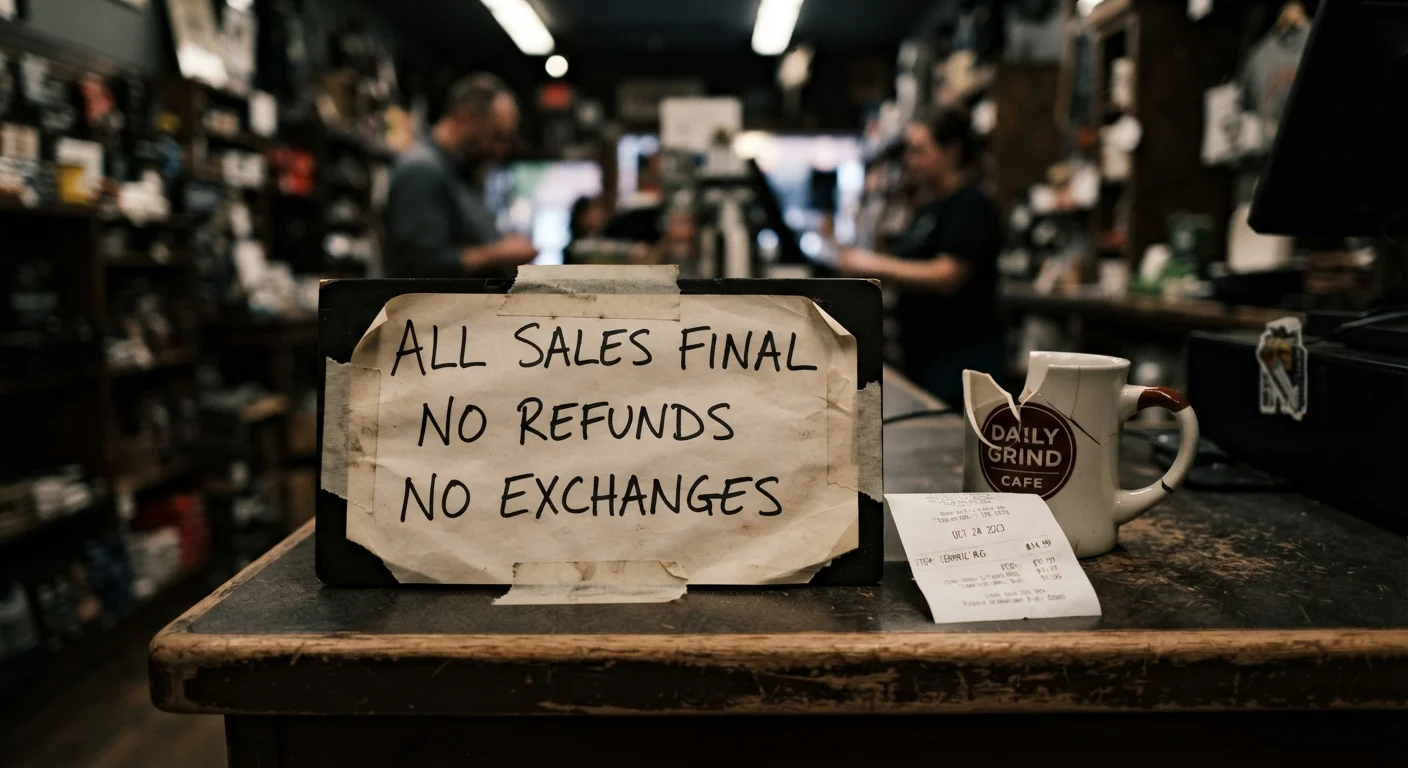
Photo: InDepthReads.com | Streamlining Learning For All editorial
Key Takeaways
- 'All sales final' is a store policy, not an override of state or federal consumer protection law.
- Defective products may entitle you to a remedy even when the retailer posted a no-return sign.
- Credit card chargebacks and state attorney general complaints are legitimate escalation paths.
- Misrepresentation of a product — verbal or written — can invalidate a no-return policy.
- Document everything: receipts, photos, and written communications strengthen any dispute.
What 'All Sales Final' Actually Means Legally
The phrase appears on signage, receipts, and checkout screens constantly — but what does it actually bind you to? In plain terms, "all sales final" is a retailer's internal policy that waives their voluntary return program. It does not, on its own, strip you of rights granted by law.
Federal and state consumer protection statutes operate independently of store policy. The Federal Trade Commission (FTC) sets baseline expectations around deceptive trade practices. Most states layer additional protections on top, particularly around implied warranties, goods that arrive defective, and products that were materially misrepresented at the point of sale.
The practical upshot: a no-return sign is enforceable for discretionary returns — you changed your mind, the color wasn't right, you found it cheaper elsewhere. It is far less bulletproof when the product is broken, dangerous, or nothing like what was advertised. For a full overview of what federal and state law actually covers, see Your Consumer Rights After a Purchase Goes Wrong.
Common Myths — and the Accurate Corrections
Consumers consistently overestimate how much a no-return policy protects the retailer — and underestimate how much protection they actually have. The pairs below address the most common misconceptions directly.
Myth
If a store posts 'all sales final,' you have absolutely no recourse for any reason.
Fact
Store policies cannot waive legal rights. Defects, misrepresentation, and safety violations may still entitle you to a remedy.
A retailer's posted policy governs voluntary returns — the kind where the buyer simply changes their mind. It does not and cannot override implied warranties under the Uniform Commercial Code (UCC), state consumer protection statutes, or federal rules around deceptive trade practices. If goods are defective or were falsely described, the sign on the wall is largely irrelevant to whether you have a legal claim.
Myth
Buying a clearance or sale item means you accept it 'as-is' with no warranty protection.
Fact
Clearance pricing does not automatically waive implied warranties. An explicit written disclaimer is generally required for that waiver to be enforceable.
Under the UCC, an implied warranty of merchantability can be disclaimed — but only through conspicuous, explicit written language (commonly the word "as-is" or "with all faults" in a noticeable location). A discounted price tag alone does not constitute that disclaimer. Consumers who purchase clearance goods that turn out to be defective may still have a valid warranty claim, depending on their state's laws.
Myth
If the product breaks after you leave the store, the 'all sales final' policy means the store owes you nothing.
Fact
Post-purchase failure from a pre-existing defect — not misuse — is often covered by implied warranty law, separate from the store's return policy.
The implied warranty of merchantability generally requires that a product function as it reasonably should for a reasonable time after purchase. If a product fails almost immediately from a defect present at the time of sale, that may constitute a breach of warranty even if the store has a strict no-return policy. The key distinction is between a defect present at purchase versus damage caused by the consumer after the fact. Document the failure promptly and in writing.
Myth
A verbal description from a salesperson doesn't matter once you've paid — only the written receipt counts.
Fact
Material misrepresentations made verbally at the point of sale can form the basis of a fraud or deceptive trade practices claim.
Consumer protection laws in most states prohibit deceptive acts in commerce, including verbal misrepresentations about a product's material characteristics — its function, condition, or included features. If a salesperson made specific claims that turned out to be false and those claims influenced your purchase decision, that may provide a legal basis to seek a remedy even under an all-sales-final policy. Written notes taken at the time of purchase, such as product descriptions from a store website or advertising, can help corroborate such claims. Also see assumptions that hurt shoppers when returns go wrong for related misconceptions.
Myth
Your only option when a retailer refuses a refund is to accept the loss.
Fact
Credit card chargebacks, state attorney general complaints, small claims court, and consumer protection agencies are all independent recourse paths.
When a merchant won't engage, consumers have multiple escalation routes that operate entirely outside the retailer's own policies. The Fair Credit Billing Act allows cardholders to dispute charges for goods that were not as described or that were defective. State attorneys general enforce consumer protection laws and accept complaints. Small claims courts handle disputes up to several thousand dollars without requiring an attorney. Each path has different timelines and documentation requirements, so acting promptly matters.
How to Protect Yourself Before and After the Sale
The best consumer protection is documentation gathered before a dispute ever starts.
~50%
Consumers unaware of implied warranty rights
Consumer advocacy surveys consistently find that roughly half of shoppers don't know implied warranty protections can apply even when stores post no-return policies.
45+
U.S. states with consumer protection statutes
Nearly every U.S. state has enacted its own consumer protection law that operates independently of federal rules, often with stronger remedies for deceptive practices.
- Read the policy before you pay. "All sales final" disclosures must generally be visible before purchase to be enforceable. A sign hidden behind a counter or printed only on the back of your receipt after checkout may not hold up. Reading a return policy before it matters walks through exactly what to look for.
- Photograph products in-store or at unboxing. Time-stamped photos showing condition at receipt are strong evidence if a defect claim is disputed.
- Keep all receipts and confirmation emails. These establish the purchase price, date, and any advertised product descriptions.
- Pay with a credit card when possible. Credit card chargebacks under the Fair Credit Billing Act provide an additional dispute path if the merchant refuses to engage.
- Know your state's implied warranty rules. Most states impose an implied warranty of merchantability on new goods — meaning the item must function for its ordinary purpose — regardless of posted store policy.
If a seller refuses to engage after a legitimate defect claim, you have escalation options beyond simply accepting the loss. Escalation paths that work covers the full sequence, from card disputes to state attorney general complaints.
It's also worth being clear-eyed about how promotional pricing can cloud a transaction before it even starts — inflated reference prices and misleading sale framing can affect your sense of what you actually agreed to pay. Why sale prices don't always mean savings covers that territory in detail.
This article provides general consumer education and is not legal advice. Laws vary by state and circumstances. Consult a qualified consumer law attorney or your state attorney general's office for guidance specific to your situation.
The content on this site is for informational purposes only and is not a substitute for professional advice. Always consult a qualified professional for guidance specific to your situation.