
Crate Training Demystified: What It Is, Why It Works, and How to Do It Humanely

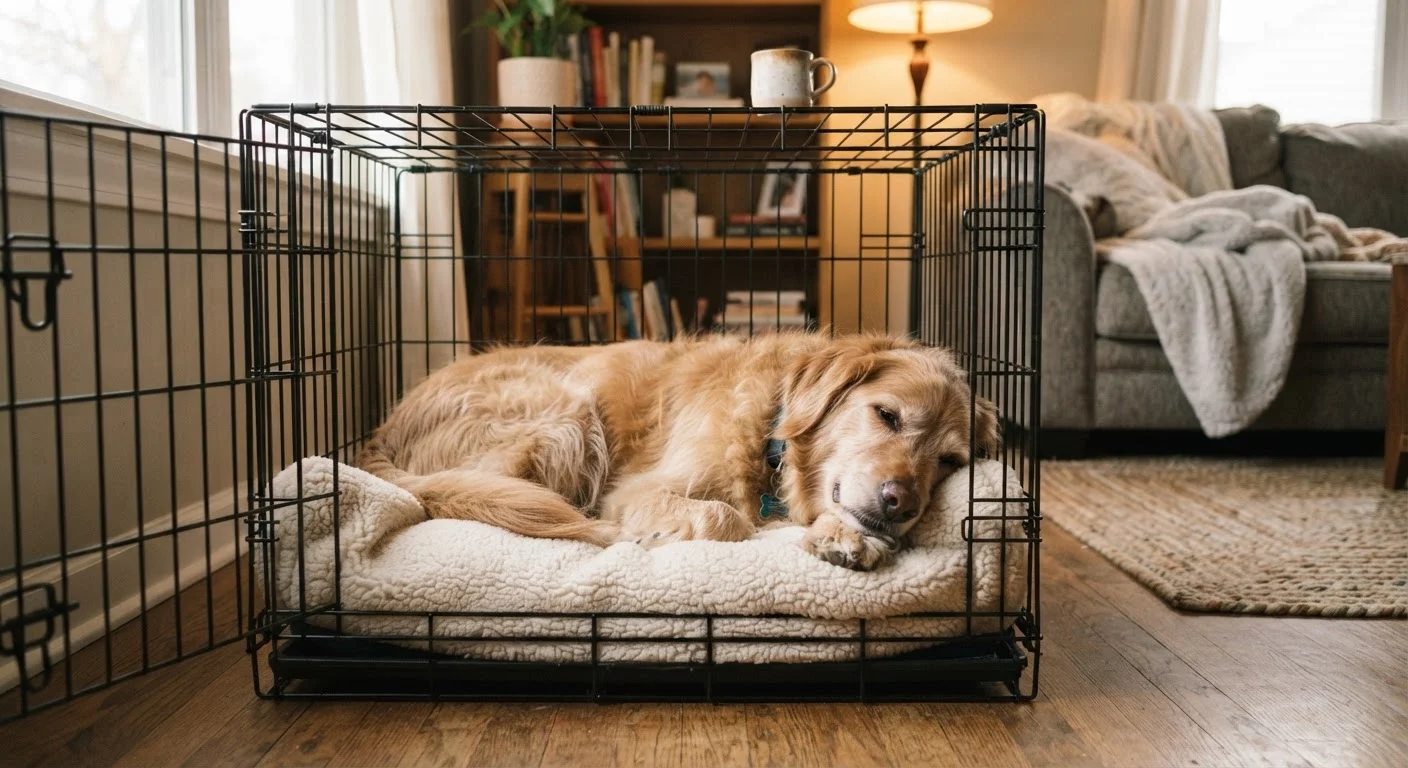
Photo: InDepthReads.com | Streamlining Learning For All editorial
Key Takeaways
- Crates leverage dogs' natural denning instincts, making them a humane management and training tool when introduced correctly.
- Forcing a dog into a crate before it's ready creates fear; gradual, positive association is essential for success.
- Crate training supports housebreaking, reduces destructive behavior, and gives anxious dogs a predictable safe space.
- Adult dogs can learn to love a crate — this process isn't limited to puppies.
- Never use the crate as punishment; doing so permanently undermines its value as a refuge.
Why Dogs Take to Crates — When Done Right
The behavioral rationale for crate training is grounded in how dogs evolved. As descendants of den-dwelling animals, dogs have a natural tendency to seek out enclosed, sheltered resting spots — under tables, behind couches, in quiet corners. A properly introduced crate channels this instinct into a dedicated, owner-provided space that the dog genuinely considers its own.
When introduced gradually using positive reinforcement, the crate becomes a reliable predictor of good things: food, rest, and security. This is the foundation of classical conditioning — pairing a neutral stimulus (the crate) with a consistently positive outcome until the crate itself triggers a calm, positive emotional response.
The training approach described here supports broader behavior goals too. If you're working through building good habits in your dog's first month, crate training is one of the highest-leverage foundations you can lay early. Understanding the core principles of timing and consistency in training will also sharpen your results throughout this process.
Make the Crate Part of Daily Life
What You'll Need Before You Start
Successful crate training requires only a few well-chosen tools and a clear understanding of what you're working toward. Rushing the process or skipping phases is the most common reason dogs develop crate resistance.
Appropriately Sized Crate
Provides enough room for the dog to stand, turn around, and lie down — but not so large that it loses the den-like security effect.
Soft Bedding or Crate Mat
Makes the crate comfortable and appealing; a worn item of your clothing can add a reassuring scent.
High-Value Treats
Used to reinforce positive associations with entering and remaining in the crate during each training phase.
Food-Stuffed Chew Toy (e.g., a rubber Kong-style toy)
Provides sustained mental engagement that keeps a dog happily occupied while crated.
Treat Pouch
Keeps rewards quickly accessible so you can deliver reinforcement at precisely the right moment.
What you will need
If you're introducing a crate to a rescue dog, move more slowly than you would with a puppy and watch closely for stress signals. Rescue dogs often carry prior associations with confinement that require extra patience. Our guide on why training a rescue dog is different covers the behavioral considerations in more detail.
Step-by-Step: Introducing the Crate Humanely
Follow these steps in sequence, spending as many sessions as your individual dog needs at each phase before moving forward. Progress is measured by your dog's comfort level — not by a calendar.
Choose and Position the Crate
Select a crate size where your dog can comfortably stand, turn around, and lie fully stretched out. Larger is not better — excess space reduces the cozy, den-like quality that makes crates appealing. For a growing puppy, consider a crate with a divider panel so you can adjust the interior size over time.
Place the crate in a room where your family spends time — a living room or bedroom corner works well. Avoid isolated or high-traffic areas. Familiarity with household sounds makes the crate feel like part of normal life rather than a place of exile.
Introduce the Crate Without Any Pressure
Open the crate door and let your dog investigate entirely on its own terms. Do not coax, push, or lure the dog inside during this phase. Place a few high-value treats just outside the opening, then just inside the threshold, and finally further toward the back — over several separate short sessions spanning a day or two.
If your dog retreats, reduce pressure and go back a step. Sniffing the outside of the crate and eating a treat nearby still counts as progress.
Build a Positive Association With Meals
Begin feeding your dog's regular meals near the crate entrance, then just inside with the dog's front feet entering, and eventually with the full bowl placed at the back of the crate. This pairs something the dog already values — food — with the physical space of the crate in a completely unstressful way.
Keep the door open throughout this phase. The goal is voluntary entry, not containment yet.
Begin Closing the Door for Short Intervals
Once your dog enters the crate willingly and eats a full meal inside, begin closing — but not latching — the door while the dog finishes eating. Open it immediately when the dog is done. Over the next few sessions, latch the door briefly, then open it before the dog shows any sign of wanting out.
Gradually extend closed-door duration in small increments: 30 seconds, then a minute, then several minutes. Always remain in the room during this phase so the dog is not yet managing separation.
Introduce Crating With You Out of Sight
After your dog tolerates several minutes in the closed crate with you present, begin stepping out of the room briefly before returning. Extend your absence gradually — five minutes, then ten, then twenty — always returning before the dog becomes distressed.
This is the phase where dogs with underlying separation anxiety will show clear signs of struggle. Go slowly, and seek professional guidance if distress persists despite a gradual approach.
Establish a Crating Routine
Consistent timing builds predictability, which dogs find genuinely calming. Crate your dog at the same points in the day — after morning exercise, during your work hours, and at bedtime — so the pattern becomes part of a familiar rhythm rather than an unpredictable event.
For puppies, a general guideline is that young dogs can be crated for roughly one hour per month of age, up to a maximum of around four hours during the day. Adult dogs can manage longer stretches, but no dog should be crated for the majority of its waking hours consistently.
Never Use the Crate as Punishment
Common Mistakes and How to Avoid Them
Most crate training setbacks stem from moving too quickly. If your dog whines, barks, or panics inside the crate, the most likely cause is that one of the earlier phases was rushed. Go back to the last stage where the dog was fully comfortable and rebuild from there — this is not failure, it's responsive training.
Watch for Signs of Distress
Puppies in the critical socialization window — generally between 3 and 14 weeks — benefit enormously from having a crate as part of their environment early. See our article on the socialization window that matters most to understand how crate comfort fits into broader early development.
Finally, remember that crate training is a tool within a broader care and enrichment strategy, not a substitute for adequate exercise, mental stimulation, or veterinary pet health and care. A well-exercised, appropriately stimulated dog will adapt to a crate far more readily than one whose broader needs are unmet.
The content on this site is for informational purposes only and is not a substitute for professional advice. Always consult a qualified professional for guidance specific to your situation.