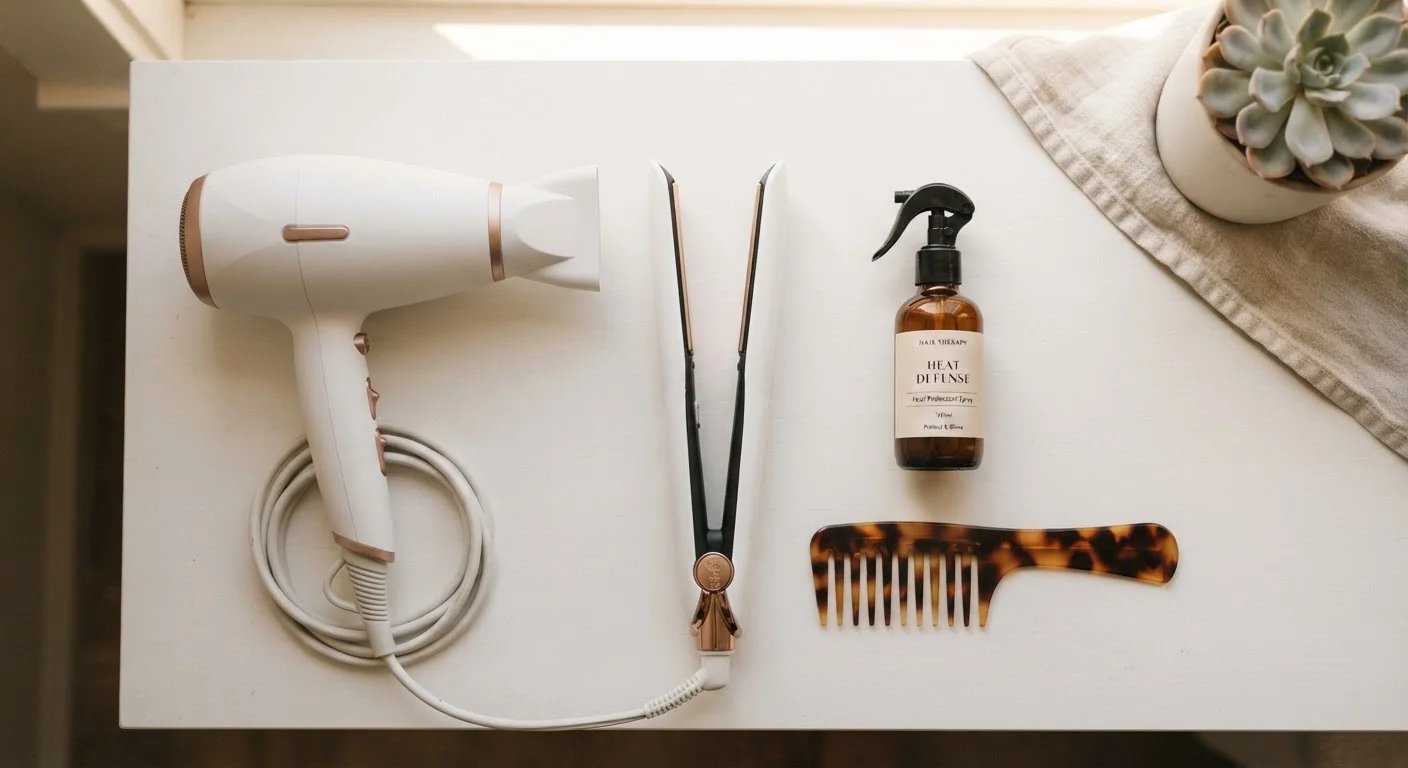
Consistent heat use doesn't have to mean damage. These evidence-informed practices help preserve hair integrity over time.
Why Heat Protection Starts Before You Plug Anything In
Heat styling can be a totally workable part of your hair routine — but the protective work actually begins before the tool even touches your hair. The condition your hair is in before you apply heat largely determines how much damage, if any, you'll experience.
Hair that's well-moisturized and free of product buildup handles thermal stress far more gracefully than hair that's already parched or coated in residue. If your scalp and strands feel perpetually gunky or weighed down, it may be worth learning about when clarifying makes sense before your next styling session.
Similarly, understanding your hair's individual properties — its porosity, density, and texture — dramatically changes which tools and temperatures will actually serve you. Hair porosity, density, and texture affect how quickly your hair absorbs and loses moisture, which in turn affects how it responds to heat.
Heat Damage Is Cumulative, Not Sudden
Unlike a burn on skin, heat damage to hair doesn't always show up immediately after one session — it builds gradually over repeated exposures. This is why consistent protective habits matter more than occasional deep treatments after the fact. Think of heat protection as a long-game practice, not a reactive fix.
Core Practices for Heat Styling With Less Damage
These aren't rigid rules — they're flexible, evidence-informed habits that work across a wide range of hair types and styling goals. Incorporate what's relevant to your routine and adjust as you learn how your hair responds.
1
Apply a heat protectant every single time, without exception.
Heat protectants form a temporary barrier on the hair cuticle that helps reduce moisture loss and surface damage from hot tools. Skipping this step — even occasionally — leaves strands vulnerable to protein degradation and cuticle lifting, both of which compound over repeated styling sessions.
Example: Spritz a lightweight heat protectant evenly through damp hair before blow-drying, then again on dry hair before using a flat iron or curling wand.
2
Choose the lowest effective temperature for your hair type.
Higher temperatures don't automatically produce better results — they just apply more stress to the strand. Fine or low-porosity hair often styles effectively at lower settings (around 300°F or below), while coarser, high-porosity hair may need more heat but rarely needs the absolute maximum.
Example: Someone with fine, color-treated hair might achieve a smooth blowout at 330°F, whereas thick natural hair might require 375°F — both are far safer than defaulting to the highest setting on every tool.
3
Always style fully dry hair with flat irons and curling tools.
Applying a flat iron or curling wand to hair that is still damp causes the water inside the strand to rapidly expand and turn to steam, which can create microscopic fractures within the cortex. This is one of the most preventable forms of heat damage.
Example: Blow-dry your hair to 100% dry (not just mostly dry) before reaching for your straightener — running a hand through each section to check for any remaining cool or damp spots is a simple checkpoint.
4
Keep tools moving and avoid multiple slow passes on the same section.
Holding a hot tool stationary on one section dramatically increases the cumulative heat exposure in that area. One or two smooth, steady passes is generally sufficient; repeated slow passes indicate you may need to check your technique, sectioning, or tool temperature.
Example: If you need more than two passes with your flat iron for a smooth result, try working with smaller, thinner sections rather than pressing harder or slowing down.
5
Build regular heat-free days into your routine.
Hair doesn't regenerate like skin — once the cuticle or cortex is damaged, that segment stays damaged until it grows out. Spacing out heat sessions gives the strand time to retain moisture and reduces cumulative stress, particularly for those who style frequently.
Example: If you blow-dry on Monday, style with a flat iron Tuesday, and then air-dry or wear a braid Wednesday through Thursday, you've already reduced your weekly heat exposure meaningfully.
6
Moisturize consistently between styling sessions.
Well-hydrated hair is significantly more resilient to heat. Dry, brittle strands lose structural integrity under high temperatures much faster than adequately moisturized ones. Moisture-sealing routines between wash days help maintain that buffer. Understanding
how oils, butters, and creams each play a different role can help you build a smarter between-session routine.
Example: Apply a light leave-in conditioner or cream to mid-lengths and ends on days you're not washing, focusing on sections that tend to feel the driest or most rough to the touch.
7
Get regular trims to remove heat-stressed ends.
The oldest parts of your hair — the ends — have experienced the most cumulative heat exposure. Damaged ends fray, split, and travel upward along the shaft if left untrimmed. Consistent trims prevent this from getting worse and keep hair looking and feeling healthy. For those with natural hair,
trimming at home without losing length is very much a learnable skill.
Example: A light dusting trim every 8–12 weeks — removing just enough to get rid of frayed ends — can noticeably improve how your styled hair looks and behaves.
Quick Wins You Can Apply Right Now
You don't have to overhaul your entire routine to start protecting your hair better. A few immediate, low-effort adjustments can make a meaningful difference in how your hair looks and feels over time.
high
Check whether your heat protectant is formulated to withstand the temperature of your specific tool — the product's label typically lists a max heat rating.
high
Section your hair before styling instead of working through it in one mass — smaller sections mean fewer passes with the tool.
medium
Lower your tool's temperature by 25–50°F from wherever you currently set it and test whether you still get the result you want.
medium
Let your hair air-dry for at least 70% of the way before finishing with a blow-dryer to reduce total heat exposure time.
medium
Apply a moisturizing leave-in or light oil to your ends the night before a styling day to give dry sections an extra hydration buffer.
For a broader look at keeping your hair moisturized between styling sessions, the guide on how to layer oils, butters, and creams is a helpful next step. And if you're curious about giving your hair a longer break from heat tools altogether, protective styles and their real benefits are worth understanding. Don't forget: a healthy foundation starts even deeper — scalp health from the inside out plays a larger role in your results than most people realize.
This article is for general informational and educational purposes only. It is not a substitute for advice from a licensed cosmetologist, dermatologist, or trichologist regarding your specific hair or scalp concerns.
The content on this site is for informational purposes only and is not a substitute for professional advice. Always consult a qualified professional for guidance specific to your situation.