
Return Policies Decoded: What Retailers Are Actually Required to Tell You

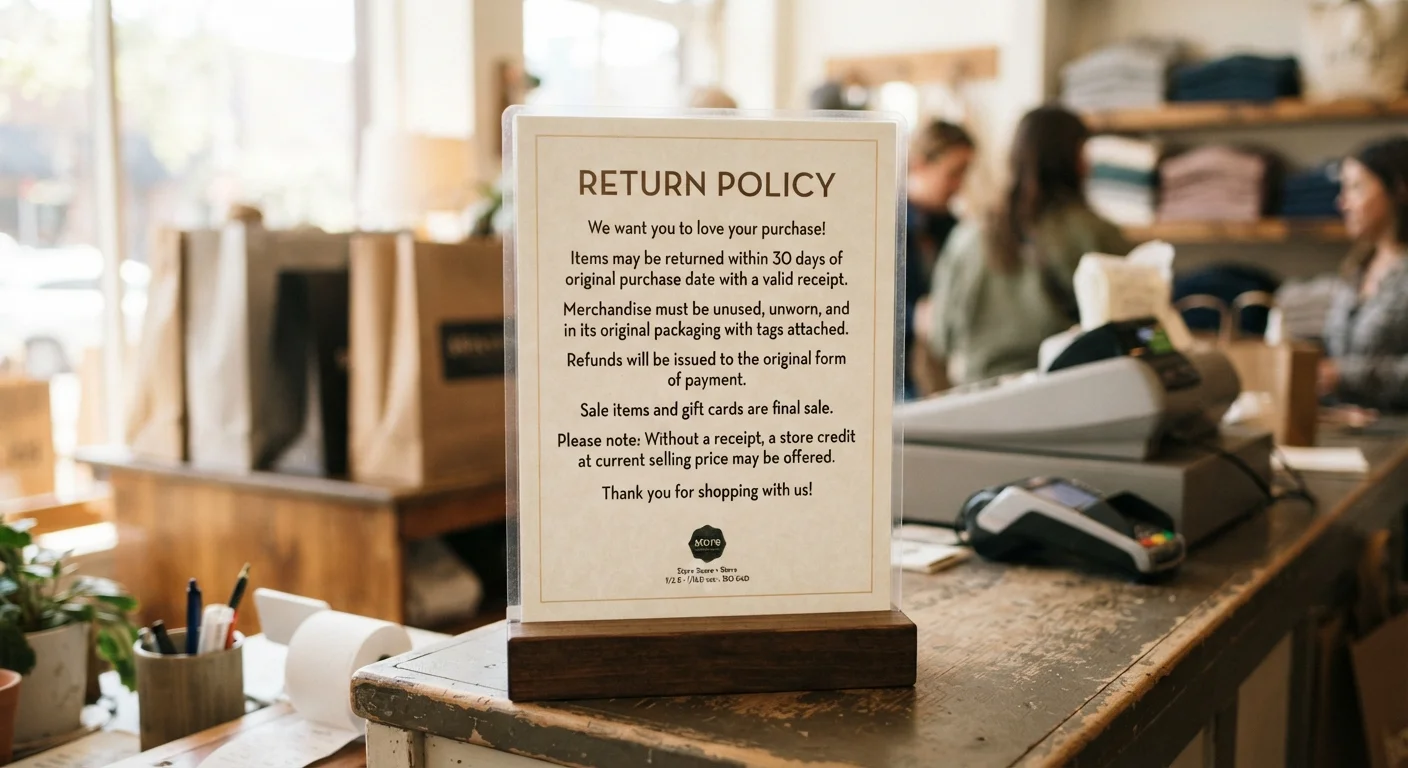
Photo: InDepthReads.com | Streamlining Learning For All editorial
Key Takeaways
- No federal law requires retailers to accept returns, but many states regulate how policies must be disclosed.
- If a store fails to post a required disclosure, some states entitle shoppers to a full refund regardless of store policy.
- Final sale, restocking fees, and receipt requirements are all legal—but must typically be communicated before purchase.
- Online retailers face additional disclosure rules, particularly for cancellation and return shipping costs.
- Keeping your receipt and reading posted policies at checkout are your strongest practical protections.
There Is No Universal Right to Return
Many shoppers assume that returning an unwanted item is a guaranteed right. It isn't—at least not at the federal level. No single U.S. law requires a retailer to accept merchandise back after a sale is complete. The decision to accept returns, and on what terms, is fundamentally a business choice.
What is regulated—in many states—is how that policy must be communicated. If a retailer imposes conditions that deviate from what a reasonable shopper might expect, those conditions generally must be disclosed before the purchase is finalized. That distinction matters: the law doesn't mandate generosity, it mandates transparency.
For a broader look at protections available to U.S. consumers, see consumer rights every American shopper should know.
Defective Goods Are a Separate Question
What State Laws Actually Require
Roughly a dozen states have explicit return policy disclosure statutes. California, New York, and Florida are among those with the most detailed requirements. While the specifics differ, a common thread runs through them: if a store's policy is more restrictive than a full-refund-within-reasonable-time standard, that restriction must be posted conspicuously at the point of sale—typically near the register or on the receipt.
Failure to comply with a state's posting requirement often has a concrete consequence: the retailer may be required to accept the return and issue a refund regardless of its unstated policy. That's a meaningful enforcement mechanism, even if it's rarely publicized.
Policies to watch for include:
- No-return or final-sale designations — must usually be disclosed on signage, the receipt, or both.
- Restocking fees — typically must be disclosed before purchase, not revealed only at return time.
- Exchange-only or store-credit-only refunds — states differ, but many require advance disclosure when cash refunds are withheld.
- Receipt requirements — if a receipt is mandatory for a return, that condition should be stated upfront.
~12
U.S. states with explicit return policy disclosure statutes
State-level consumer protection laws vary widely; shoppers should verify the rules in their specific state.
30 days
FTC default shipping window for mail and online orders
Under the FTC's Mail or Telephone Order Rule, sellers must ship within 30 days if no other timeframe is stated, or offer a full refund.
67%
Shoppers who check return policies before purchasing
According to a National Retail Federation consumer survey, a majority of shoppers say return policies influence their buying decisions.
Online Retailers Face Additional Obligations
E-commerce adds a layer of complexity. The FTC's Mail or Telephone Order Merchandise Rule requires online and mail-order sellers to ship items within the time promised—or within 30 days if no timeframe is given—and to offer cancellation and full refunds when they cannot. This rule does not directly govern return policies for delivered goods, but it sets a baseline for the transaction.
More practically, most states with disclosure laws interpret their requirements to apply to online checkout flows as well. A return policy buried in a terms-of-service document linked at the footer of a website is unlikely to meet a "conspicuous disclosure" standard. The policy should be accessible at or before the point of purchase.
For a detailed comparison of how return friction differs between channels, see online vs. in-store returns.
Screenshot the Policy Before You Buy Online
What Retailers Are Not Required to Tell You
Disclosure law has limits. Retailers are generally not required to offer a generous policy—only to disclose the one they have. A store can legally sell all items as final sale, charge a 25% restocking fee, or require an original receipt in pristine packaging. None of that is inherently unlawful, provided it's communicated before the transaction is complete.
Stores are also not required to explain why a policy exists, offer exceptions for defective merchandise beyond warranty obligations, or match competitors' more lenient terms. Understanding these boundaries helps shoppers know where to focus: on reading the policy before buying, not on assuming rights that don't exist.
Knowing what fine print actually means before you reach the register is a learnable skill. Restocking fees, return windows, and fine print walks through exactly what to look for. And if you've already encountered a return gone wrong, common assumptions that hurt shoppers explains why the outcome may have differed from your expectations.
Frequently Asked Questions
The content on this site is for informational purposes only and is not a substitute for professional advice. Always consult a qualified professional for guidance specific to your situation.