
Zero-Based Budgeting vs. the Envelope Method

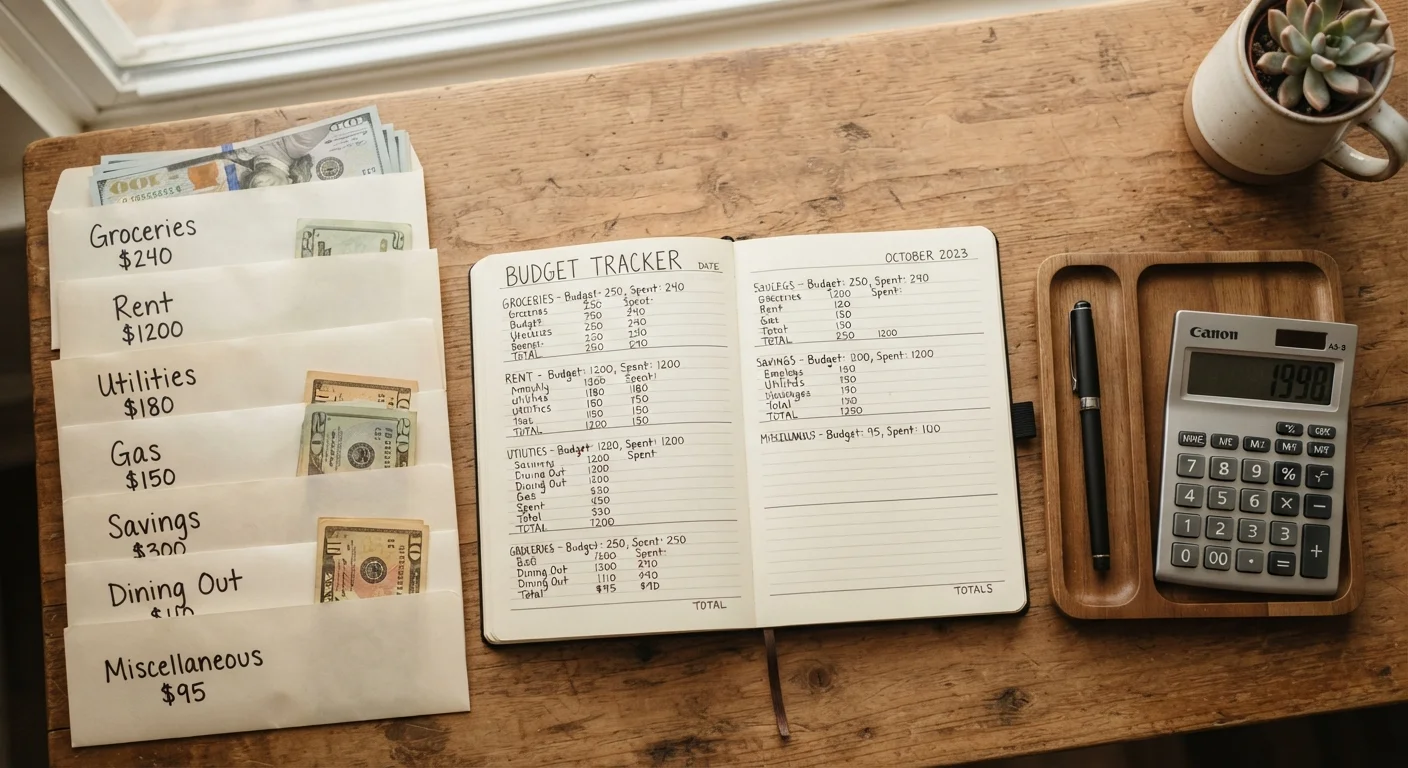
Photo: InDepthReads.com | Streamlining Learning For All editorial
Key Takeaways
- Zero-based budgeting assigns every dollar of income to a category so income minus expenses equals zero.
- The envelope method allocates physical cash into labeled envelopes; once the cash is gone, spending in that category stops.
- Zero-based budgeting works well digitally and suits people who prefer planning over physical cash handling.
- The envelope method is most powerful for curbing overspending in variable categories like groceries and dining.
- Both systems require knowing your income and expenses — a foundation covered in understanding fixed vs. variable costs.
- Neither method is universally superior; the best budgeting system is the one you will actually maintain.
How Each System Works
Both methods are built on the same premise: spend intentionally, not reactively. But they achieve that through fundamentally different mechanics.
Zero-based budgeting (ZBB) starts with your total monthly income and subtracts every planned expense — rent, utilities, groceries, savings contributions, debt payments, subscriptions — until the remaining balance is zero. That zero doesn't mean you've spent everything; it means every dollar has a designated job, including dollars earmarked for savings or an emergency fund. If you're new to the concept, Your First Budget: A Plain-English Starting Point is a solid foundation before layering in ZBB.
The envelope method is more literal. You withdraw cash equal to your spending budget for variable categories, then divide that cash into labeled envelopes — one for groceries, one for gas, one for dining out, and so on. You spend only what's in each envelope. No borrowing between envelopes (or at least, doing so deliberately and consciously). Fixed expenses like rent or insurance are typically handled separately via check or automatic transfer since they don't benefit much from physical cash separation.
| Criterion | Zero-Based Budgeting | The Envelope Method |
|---|---|---|
| Core mechanism | Assign every dollar to a category | Divide physical cash into labeled envelopes |
| Works best for | Full-budget planners, variable income | Overspenders in specific categories |
| Digital-friendly | Yes — apps and spreadsheets work well | Limited — cash-based by design |
| Flexibility | High — easy to adjust categories | Low — intentionally rigid |
| Handles fixed expenses | Yes — all expenses are included | Typically excluded from envelope system |
| Spending accountability | Requires self-discipline and honest tracking | Built-in via physical cash limits |
| Setup effort | Moderate — requires monthly planning session | Low — withdraw cash and divide |
| Online purchase compatibility | Seamless | Requires a workaround |
Flexibility, Control, and Real-World Trade-Offs
Understanding fixed vs. variable expenses is essential before choosing either system, because both methods treat these two expense types differently.
Zero-based budgeting is highly flexible. You can adjust category amounts month to month, account for irregular income, and track everything digitally. Its weakness is that it requires discipline and honest self-reporting — moving money between digital categories is easy, and it can tempt people to rationalize overspending. The system works best when you treat your budget as a living document you revisit weekly, not a plan you set and forget.
The envelope method is the opposite: inflexible by design, and that's the point. The physical constraint of cash is its primary power. Research into consumer behavior consistently shows that people tend to spend more freely when using cards compared to cash, a pattern sometimes called the "pain of paying." The envelope method reintroduces that friction deliberately. Its trade-off is practicality — carrying envelopes of cash is inconvenient, some merchants don't accept cash, and online purchases require a workaround (such as a dedicated debit card with a preset balance).
Hybrid Approaches Are Common
For a broader look at how these two systems fit among other approaches, see Budgeting Methods Compared. And if you're weighing zero-based budgeting against a goal-first approach, Goal-Based Budgeting vs. Zero-Based Budgeting covers that contrast directly.
Which System Fits Your Life?
There is no objectively superior method. Both zero-based budgeting and the envelope method have helped people pay down debt, build savings, and reach financial goals they previously struggled to hit. The deciding factor is almost always adherence — a system you maintain imperfectly beats a system you abandon after two weeks.
1 in 3
Americans who follow a detailed household budget
Gallup polling has found that roughly one-third of U.S. adults report maintaining a detailed monthly budget, suggesting most households manage money without a formal system.
~18%
More spent when paying by card vs. cash
Behavioral economics research, including work by Drazen Prelec and Duncan Simester, has found consumers tend to spend meaningfully more when using cards compared to cash, a key rationale for the envelope method.
If you tend to overspend on discretionary categories and struggle to stop once a card is in your hand, the envelope method's hard physical limit may be exactly the accountability structure you need. If you prefer data, enjoy monthly planning sessions, or your income varies, zero-based budgeting's flexibility and digital compatibility make it the stronger fit.
You can also combine elements: use zero-based budgeting as your master plan and apply the envelope method only to the two or three categories where you historically overspend. Many people working toward savings and debt payoff goals find this hybrid approach gives them both the big-picture visibility of ZBB and the behavioral guardrails of cash envelopes where they need them most. The 50/30/20 framework offers yet another lens — see The 50/30/20 Rule Explained if you want a percentage-based alternative to compare.
This article is for general informational and educational purposes only and does not constitute personalized financial advice. Consider consulting a qualified financial professional for guidance specific to your situation.
The content on this site is for informational purposes only and is not a substitute for professional advice. Always consult a qualified professional for guidance specific to your situation.